
Origin Staffing - Thoughts on Recruitment
Hiring a Tax Structuring Counsel for a Credit Investment Manager (JD / LLM Profile Recruiting) – Search Agency Case Study
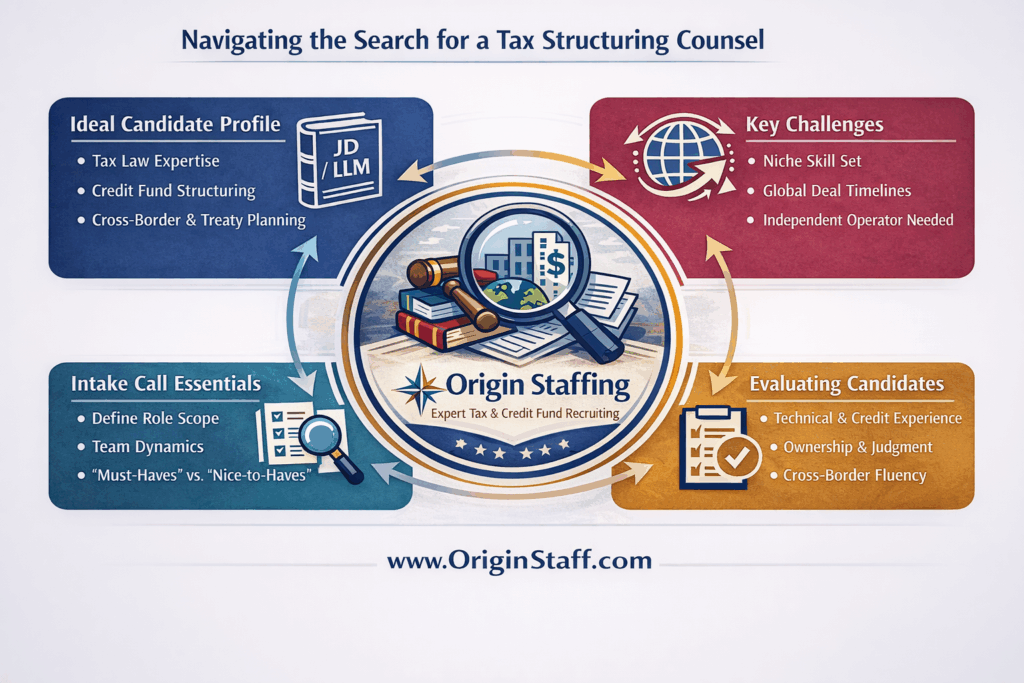
When investment managers call a recruiting agency for tax hiring, it’s rarely because the title is unusual. It’s because the intersection of skills is scarce, the work touches high-stakes decisions, and the operating environment is too lean to absorb a mis-hire. This search was a Tax Structuring Counsel seat embedded in a credit fund investment platform. The mandate was clear: bring in a senior tax professional with legal fluency (JD strongly preferred), fund structuring depth, and the practical judgment to execute under deal-driven timelines – with credibility across investment professionals, legal, finance, compliance, and external advisors.
Why this role exists (and why it’s structurally different)
Many tax org charts are built around compliance cadence and reporting cycles. This role was different: it sat closer to the point of decision-making. The Tax Structuring Counsel was expected to advise on (and often quarterback) tax implications across:
- Partnership and fund structures (Subchapter K mechanics, allocation considerations, structuring constraints)
- Debt instruments and financing mechanics (credit products, workouts/restructurings, bespoke terms)
- Cross-border investors and treaty implications (with a “document it, defend it” mindset)
- Transaction execution (often on short notice; tax pulled in late is a recurring reality)
- Legal documentation (loan agreements, LPAs, side letters, credit agreements, negotiated terms)
- Coordination across internal teams and external advisors (cost-effective, high-quality oversight)
Partnership tax fundamentals are governed by Subchapter K and the related rules and guidance. See the IRS partnership overview and related partnership resources below.
The operating model was also lean. The hiring manager had significant personal workload and relied on outside advisors selectively – meaning the hire needed to own workstreams, reduce dependency on external resources, and improve throughput without sacrificing rigor.
What made the search unusually difficult
This was not “find a tax attorney” and it wasn’t “find a fund tax person.” It was the intersection.
1) JD / legal-document fluency materially narrowed the market
The preference for a true tax-law profile wasn’t cosmetic. The team needed someone who could independently read and interpret complex documentation (loan agreements, structuring documents, partnership agreements, side letters) and translate that into actionable tax recommendations – without relying on another function to “explain the paper.”
2) Credit fund structuring expertise lives in small pockets
A large percentage of tax professionals can speak to private funds generally. A much smaller subset has meaningful exposure to credit-oriented structuring, where the mix can include distressed positions, complex financing mechanics, investor constraints, and cross-border considerations that surface unpredictably.
3) The role demanded ownership, not “support”
This was the most important nuance. The team didn’t need another strong technical contributor who thrives with defined assignments and frequent check-ins. They needed someone who could:
- Make sound judgments with incomplete information
- Communicate clearly and pragmatically
- Run a process end-to-end
- Be a trusted partner to investment and legal stakeholders
4) Global time zones + transaction cycles shape the week
The expectation was not “always on,” but it also wasn’t a strict 9 – 5 model. This is common in global investing environments: the workload is event-driven (transactions, fundraises, closings), and the successful hire is someone who can flex when it matters.
5) Offer mechanics are part of the search (not an afterthought)
At senior levels, the “yes/no” decision often turns on practicalities: incentive payout timing, relocation constraints, sign-on expectations, and package structure tradeoffs. If these aren’t surfaced early, the process can look smooth – until it collapses late.
The highest-leverage hour: the intake call
A job description cannot carry a search like this. A strong intake is a working session that turns the role into screenable realities. We structured intake around four categories:
1) The real work mix (not generic responsibilities)
We broke down what the person would actually be doing weekly and monthly:
- How much structuring vs. transaction support?
- What are the recurring deliverables vs. ad hoc urgencies?
- When does tax enter deals – early, midstream, or late?
- Where does treaty work show up in practice?
- What’s currently handled by external advisors – and what needs to migrate in-house?
This clarity prevented misalignment later and made outbound outreach far more precise.
2) Stakeholder map + decision dynamics
In senior tax roles inside investing environments, success is heavily stakeholder-driven. We documented:
- Who the Counsel interacts with daily
- Who sets priorities
- Who challenges conclusions
- What requires escalation vs independent judgment
- Where friction typically appears
3) Non-negotiables vs strong preferences
In specialized hiring, everything can start sounding mandatory. Separating must-haves from preferences creates a realistic funnel and prevents inadvertently eliminating the entire market.
4) The hidden requirement: autonomous ownership in a lean team
This was the single biggest factor. The team needed someone who operates like an internal owner, not an external advisor – and not a junior waiting for instructions.
How we built the candidate market map (without diluting)
For a role like Tax Structuring Counsel, volume creates noise. Precision produces outcomes.
We mapped three primary lanes:
- In-house tax at investment platforms with meaningful credit activity
- Big 4 structuring / transaction tax with demonstrable financial services credit exposure
- Fund structuring law firm talent with the operating style and motivation to move in-house
Then we screened for proof – not just keywords.
What “proof of fit” looks like in Tax Structuring Counsel searches
Resumes can show where someone worked. They rarely show how someone operates. We screened consistently across four dimensions:
1) Can they do the work technically – through real examples?
Not in theory. Through examples where they:
- Handled structuring tradeoffs
- Documented and defended positions
- Navigated ambiguity
- Advised stakeholders who needed practical answers
Partnership tax is foundational here – both in concept and in the reality of compliance and reporting. IRS Pub. 541 is a useful baseline reference for partnership taxation concepts, and the IRS Form 1065 instructions are a practical anchor for filing and reporting mechanics.
2) Is their credit exposure real and transferable?
Credit fund work varies widely. We looked for candidates who could discuss structures they supported, investor implications, and how tax integrated with the investment process (not just “reviewed memos”).
3) Are they fluent in cross-border / treaty realities?
Treaty research matters most when paired with execution:
- What is the position?
- What documentation supports it?
- What investor disclosures follow?
- How it flows into partnership/investor reporting?
On the reporting side, international tax considerations increasingly drive K-2/K-3 data requirements for partnerships. This is one of many reasons cross-border competence matters even for “U.S.-based” funds.
4) Do they operate like an in-house owner?
This is where many “strong” resumes don’t convert. We assessed whether the person could articulate:
- What they personally owned
- What deliverables they produced
- How they triaged urgent work
- How they managed external advisors cost-effectively
- How they drove a process forward without heavy oversight
Why structured feedback after each round was essential
Senior interview processes tend to be conversational. Technical testing is often light, and decisions are made on trust, judgment, and perceived fit. That creates risk if feedback is vague.
We built a structured feedback loop after each round to sharpen signal and keep momentum. We asked interviewers to be explicit about:
- What was tested (technical depth vs stakeholder judgment vs culture fit)
- Where the candidate inspired confidence (ownership, clarity, maturity)
- What concerns surfaced (pace tolerance, role specificity, stakeholder handling)
- What the candidate did not answer clearly (often the most important signal)
Our recruiters debriefed each candidate in detail to confirm:
- What they believe the role truly is
- What energizes them
- What concerns them
- What they still need clarity on
This feedback loop is a major reason agencies can add value beyond sourcing: the interview process becomes a data stream, and the search tightens materially round-by-round.
What actually decided the hire
By the time finalists emerged, multiple candidates were capable technically. The decision did not come down to marginal technical differences. It came down to operating fit:
- Clear ownership mindset in a lean environment
- Ability to work through documentation and structuring issues without heavy supervision
- Stakeholder fluency with investment professionals, legal, and finance
- Comfort with deal-driven timelines and global touchpoints
- Process orientation: someone who improves how work flows over time
A Tax Structuring Counsel role is ultimately a trust role. The strongest profiles communicate that they can reduce risk and increase throughput simultaneously – by being rigorous, responsive, and practical.
Education signals that matter in this niche (JD / LLM)
For tax structuring counsel searches, advanced tax education can be a real signal – particularly when paired with evidence of applied fund work. Strong candidates often come from (or supplement with) programs like:
- NYU Law Graduate Tax Program (LLM in Taxation)
- Boston University Law – LLM in Taxation / Graduate Tax Program
- Georgetown Law – Taxation LL.M.
The key is not the credential alone. It’s credential + deal-context execution.
Practical technical resources (useful for hiring managers and candidates)
When the work sits at the intersection of partnerships, credit structures, and cross-border investors, these are practical reference points that often come up in real workstreams:
Partnership tax baseline:
Partnership reporting mechanics and international reporting:
High-impact fund economics topic (carried interest reporting):
Partnership audit regime awareness (relevant to many complex partnerships):
Hedge fund structuring overview (helpful orientation for common structures):
Cross-border compliance framework that often intersects with investor profiles:
These resources are not meant to replace practitioner judgment, but they are helpful anchors for aligning hiring managers and candidates on the realities of the work.
Lessons for any firm hiring a Tax Structuring Counsel
If your firm is building tax capability closer to the deal process, these points drive outcomes:
- Start with truth. Candidates opt in/out based on autonomy, pace, and stakeholder intensity more than the title.
- Define the work. If you can’t articulate deliverables and decision rights, you won’t screen effectively.
- Separate must-haves from preferences. Otherwise you unintentionally eliminate the market.
- Prioritize ownership in screening. Technical strength is necessary; independence is what makes the hire work.
- Treat feedback as a recruiting tool. Structured feedback improves speed and quality.
- Address offer mechanics early. Relocation and incentive timing are normal; surprises are optional.
Where an agency partner adds the most leverage
Specialized hires succeed when the process is engineered, not improvised. For roles like Tax Structuring Counsel – where the pool is narrow and the role touches core investment decisions – the agency’s job is to bring:
- A mapped, targeted view of the market
- Disciplined screening for proof of fit
- Process control through interviews, calibration, and offer execution
That combination is what turns a “hard search” into a predictable outcome.
If it’s helpful to talk through a current hire, you can reach us via Contact, and follow updates on our LinkedIn company page.
Search was led by Andrei Nikulin – Head of Recruiting at Origin Staffing