
Origin Staffing - Thoughts on Recruitment
From LinkedIn Content to a Signed Offer: Placing a Senior Associate into Tech Investments Finance at a Global Investment Firm
Executive Summary
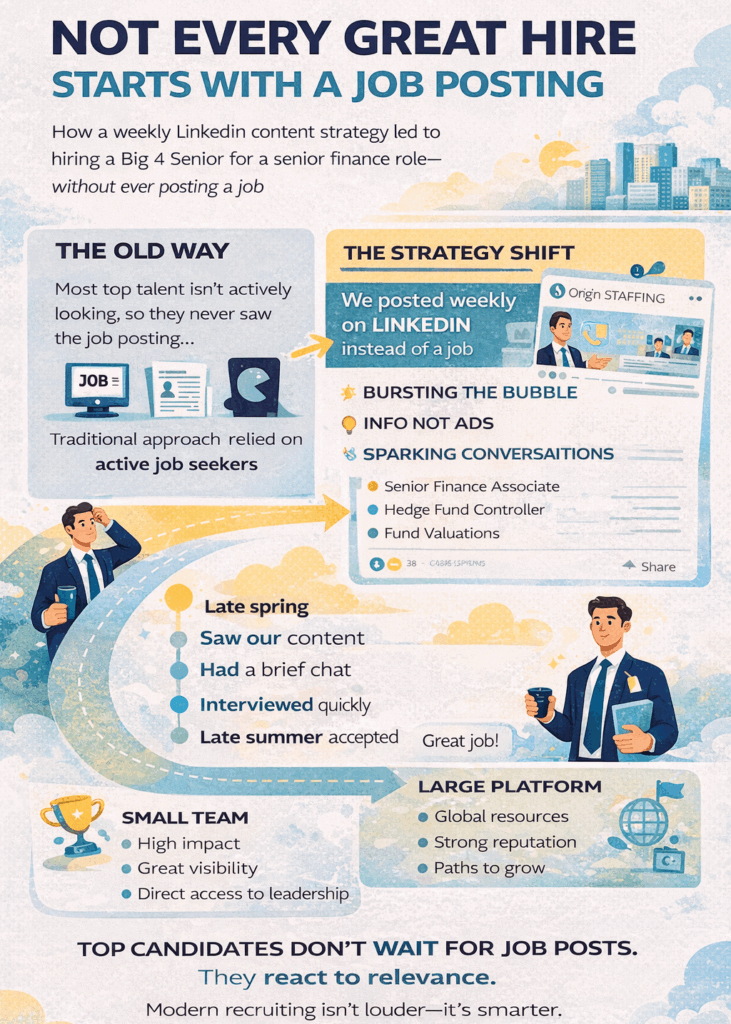
Origin Staffing partnered with a global alternative investment platform to place a Senior Associate, Tech Investments (Back Office Finance) supporting a technology-focused investment strategy. This case study highlights two repeatable lessons: small teams at a large company can be a premium pitch for top talent, and consistent, value-first content can create inbound candidate flow. In this search, an inbound message driven by a weekly LinkedIn series turned into a signed offer within a tight timeline, after a fast interview sprint and a clean close on start-date alignment.
Outcome: submitted in early summer and signed by the end of the month after a decisive process and careful handling of timing constraints tied to a relocation back to Boston.
The Inbound Message That Started It
This placement began the way many modern searches do: not with cold outreach, but with a candidate raising their hand.
Origin Staffing runs a weekly LinkedIn series that highlights the hottest roles in the market. Over time, that consistency becomes signal. Candidates who are considering a move use it as a pulse-check: what’s real, what’s active, and what’s worth talking about right now?
In late spring, a high-performing Big 4 senior reached out to learn more about the Boston market and when the “right time” was to start exploring — because they were targeting a move back later in the summer.
The instinct was understandable: many candidates assume they should wait until they’re closer to the move date. But the reality is that the best seats don’t wait. Early summer hiring cycles move quickly, and the most attractive roles often fill before candidates feel “ready.”
This search started inbound, which is exactly why consistent market-facing content matters—strong employer/recruiting branding isn’t fluff; it directly impacts who reaches out and when (SHRM’s guide on employer branding and attracting talent).
So we encouraged them to start the process immediately, with a simple framing: you’re not committing — you’re gathering signal.
Why the Small-Team Pitch Landed
The candidate didn’t want to trade one silo for another. They were ready to leave public accounting, but they didn’t want the next role to feel like a narrow lane with limited ownership.
That’s where this seat clicked.
Within a global firm, the finance function supporting a technology investing business often operates like a lean unit. Candidates feel the difference quickly: fewer layers means more accountability, but it also means a faster learning curve, more cross-functional exposure, and the chance to wear multiple hats while still being backed by the platform’s resources and standards.
When candidates choose a smaller team inside a big platform, they’re often choosing clearer operating norms and faster collaboration—especially as modern organizations evolve how teams work (see Harvard Business Review’s recent perspective on teamwork).
That combination is hard to find. It’s also a very real differentiator when you’re competing for top talent in an early-to-mid career transition.
The Ownership Move: Submitting Strategically
As part of the initial conversation, we discussed several relevant Boston opportunities. To protect ownership while keeping optionality open, we made an initial submission to a closely aligned role within the same broader platform.
Once the candidate received that notification, they clarified something important: they had a strong preference for the Tech Investments back office finance seat. The reason wasn’t compensation or brand — it was the operating model. A smaller team sounded more interesting and more aligned with what they wanted next.
We moved quickly to submit them to the Tech Investments role and get them in front of the hiring team right away. In fast markets, speed isn’t about pressure — it’s about preserving momentum when the fit is obvious.
The Interview Sprint: When the Team Sees It, They Move
The process accelerated immediately.
After the first round, feedback came back unusually fast and unusually strong. The team didn’t just like the candidate — they were excited. That level of conviction tends to produce the best interview experiences because the process becomes less about “checking boxes” and more about validating operating fit.
Instead of waiting for a formal next step, the team scheduled a relationship-building coffee chat with a current senior while they were traveling the following week. It served as a real preview of the role: how quarter-end pressure feels, what cross-functional collaboration looks like, and what “ownership” means when the team is lean.
Same-day feedback came again. The process moved into an in-person final round in Boston shortly after, with broader stakeholder exposure — including members of the investment team.
In small teams at a large company, that stakeholder exposure is the point. The finance seat sits close to the investment engine. The team needs someone who is technically solid and comfortable operating across partners without heavy supervision.
As one hiring leader described the operating reality during the process:
“This seat sits close to everything: the administrator and auditors on one side, the investment team and portfolio reviews on the other, and LP/IR requests running through the middle. The right person has to be technically solid and also stakeholder-ready from day one.”
What They Were Really Hiring For (Not a Checklist)
It would be easy to reduce this seat to a list of fund responsibilities. But that wasn’t the hiring thesis.
The team wasn’t just hiring for a resume that said “fund exposure.” They were hiring for a person who could run clean processes, communicate clearly across stakeholders, and operate with judgment in a small-team environment.
That meant prioritizing signals like:
- ownership under deadline,
- clarity of communication,
- ability to manage external providers,
- comfort with ambiguity,
- and the judgment to know what to escalate vs. solve.
The only “on-paper” wrinkle was credential-related: the candidate wasn’t pursuing the CPA and didn’t plan to. We addressed it directly, because avoiding it would create unnecessary doubt later.
In lean teams, success is less about checking boxes and more about judgment, communication, and execution across stakeholders—an operating model many large firms have leaned into as they build more “agile” structures (McKinsey’s overview on agile organizations).
In seats like this, credentials can matter — but they’re often less predictive than rigor, independence, and stakeholder readiness. This candidate consistently demonstrated those traits in both screening and interviews, which is why the credential question didn’t become a blocker.
The Only Real Tension: Start Date Alignment
After finals, both sides were excited. The team moved into references — the signal that an offer is next.
That’s when the only meaningful friction appeared: timing.
From the beginning, the candidate had been transparent that they were relocating back to Boston and targeting a late-summer / early-fall move. During the interview process, that timeline was discussed as workable.
At offer, internal urgency tightened the desired start date.
This is where many processes go sideways. Candidates don’t usually backpedal because they dislike the role — they backpedal when the “yes” forces a start that feels misaligned with what they were upfront about and what was implied as feasible.
We handled it by reframing the conversation away from preference and toward outcomes.
Starting too early, right before a pre-planned commitment, compresses onboarding and reduces early traction. In a small team, the first month matters. A misaligned start date can weaken the ramp in a way that isn’t obvious until later — and that becomes retention risk.
So we positioned the request as a ramp-quality decision: a slightly later start would allow the candidate to relocate cleanly, begin with full focus, and build early momentum rather than burning it.
The team aligned on a later start date that still met business needs. The candidate accepted and the offer moved to signature.
Close and Outcome
The offer landed where it needed to for a relocation: low six-figure base + bonus + profit sharing + a sign-on to support the move. We didn’t counter on comp; the close was timing.
The larger takeaway is what the overall process demonstrated. This role had been open long enough that the team was eager to find the right person — but they still prioritized quality, stakeholder fit, and momentum. Once conviction was there, the process moved quickly and decisively, and the only friction point was handled in a way that protected long-term success.
What This Search Reinforced
- Small teams at a large company + big platform is a powerful pitch when you explain the operating reality (visibility, ownership, cross-functional scope).
- Consistency creates inbound. Useful content isn’t branding — it’s pipeline.
- Speed comes from decisiveness, not pressure. Tight feedback loops reduce candidate drop-off.
- Start dates are risk management. Protect the ramp and you protect retention.
Frequently Asked Questions
Why do small teams inside large firms recruit so well?
They combine breadth and visibility with the resources, stability, and career runway of a global platform.
How was this candidate sourced?
Inbound through a weekly LinkedIn series highlighting the hottest roles in the market.
What made the team move so quickly?
Clear fit, fast feedback, and a process designed to maintain momentum once conviction was there.
Does “no CPA” matter for roles like this?
It depends on the seat. In this case, ownership, rigor, and stakeholder readiness were more predictive than credentials.
What was the biggest closing risk?
Start-date alignment tied to relocation and onboarding effectiveness.
How long did the process take?
A tight summer timeline from submission through signature within the month.
What’s the most common failure mode in searches like this?
Mis-selling the role as narrow finance work instead of a high-ownership, cross-stakeholder seat.
What should candidates ask to validate “small team” reality?
What they’ll own in the first 30–60 days, how quarter-end actually runs, and who their stakeholders are.
Work with Origin Staffing
If you’re hiring for high-ownership seats in finance, accounting, operations, technology, or compliance — especially where the “real job” is more complex than the job description — Origin Staffing can help translate operating reality into a decision-grade scorecard and run a process that closes.
- Contact us here
- See our other stories and experiences!
- Find us on LinkedIn
This search was led by Devin Martinez – Recruiting Manager at Origin Staffing.