
Origin Staffing - Thoughts on Recruitment
A+ Finance Hiring Beyond Titles
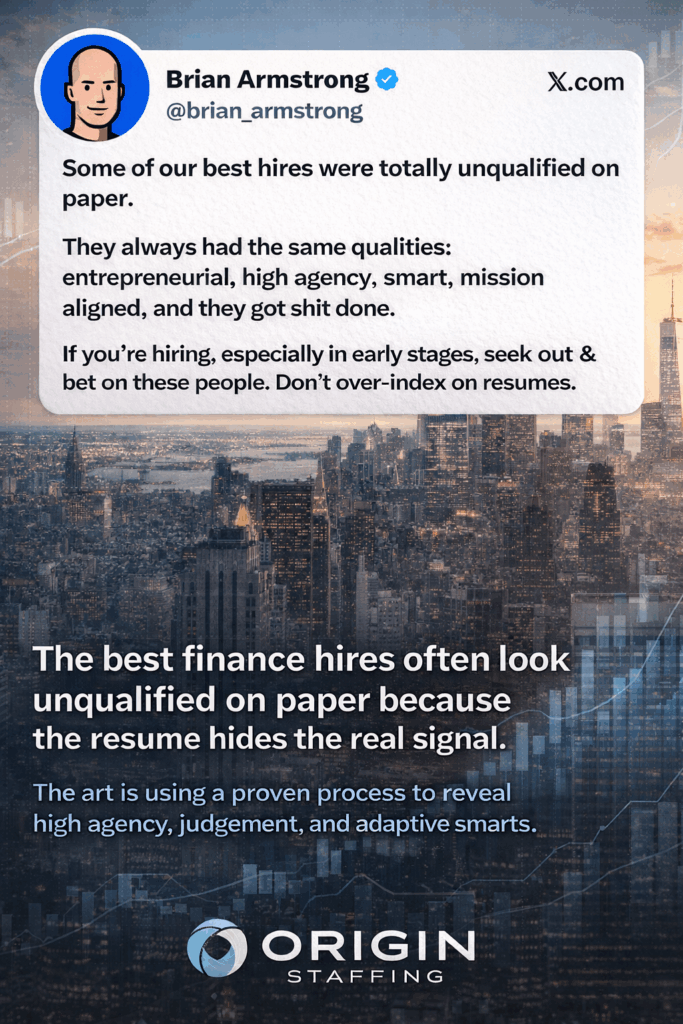
In every hiring story worth retelling, there is a moment where the resume did not predict the outcome. The person looked wrong on paper, then became the one everyone relied on when things got messy.
In a recent post, Brian Armstrong argues that some of the best hires can look unqualified on paper, yet share a common profile: entrepreneurial, high agency, smart, mission aligned, and relentlessly execution oriented (paraphrased). He is pointing at a real hiring truth: in early stage environments, outcomes come from judgment more than from perfect title matching.
What the post misses is the difference between missing labels and missing fundamentals. In finance and accounting, especially in SEC reporting, SOX, ICFR, technical accounting, tax, and compliance, you cannot “willpower” your way through the wrong technical base. But you also cannot build a durable finance function by hiring only for pedigree and exact prior scope. The best candidates are often the ones whose resumes under describe their range, because their work was embedded in chaos, not neatly packaged in job titles.
COUNTER INTUITIVE yet often correct: Hired candidate with high sense of urgency who hasn’t done 50% or more of the position responsibilities, has the highest upside.
This is where Origin’s lens becomes practical. “High agency” is not a vibe. It is observable, you just have to know what to look for and more importantly, know how to pitch them correctly. It shows up as a close that tightens month over month, a memo that survives audit scrutiny, a controls posture that improves without drama, and stakeholder communication that reduces surprises. The way you find it is not by scanning for keywords.
In accounting & finance hiring, some of the strongest “unqualified on paper” candidates are Big 4 and advisory talent moving into in house roles that are meaningfully different. Audit to SEC reporting. Risk advisory to SOX and internal audit leadership. Accounting advisory to technical accounting and policy. The resume may not say “owned the close,” but the file tells you whether they can own it: writing quality, judgment under ambiguity, ASC guidance research with ability to debate the technical scenarios, and the ability to build repeatable process. We see this pattern constantly in searches like our Assistant Controller SEC reporting case study, where the winning profile blends technical bar with builder instincts.
Actionable takeaway: The best hires often feel like a bet, but the bet gets smaller when you know exactly what proof looks like.
Happy Hunting & Boldly Forward,
Andrei
Andrei Nikulin – Head of Recruiting – Origin Staffing
Q and A section for hiring managers
- What does “unqualified on paper” look like in finance and accounting, without lowering the bar?
It usually means the title and industry labels do not match your posting, but the person has already done the underlying work: ownership in ambiguity, clean judgment, and repeatable process building. In technical accounting and policy, the bar is fundamentals plus writing quality, not exact prior job title. - How do I recruit for a technical accounting or accounting policy role?
Learn how to pitch the opportunity correctly first, then proceed with outputs: the quality of accounting conclusions, the memo standard, the disclosure discipline, and the ability to partner with auditors without rework. Then define proof points for each output: examples of judgment calls, how the candidate framed alternatives, and what they would do differently now. - What should I screen for in a first call with a technical accounting candidate?
Ask for one real topic they owned end to end, then go deep on their reasoning, not the conclusion. Listen for how they handle uncertainty, how they write, and whether they can translate accounting into stakeholder decisions. - How do I assess whether someone can “own the close” if their resume does not say close ownership?
Look for signals of operational control: how they improved cadence, reduced surprises, tightened tie outs, or built a checklist that actually changed behavior. The question is not “did you close,” it is “how would you build a close process others could run.” - What is the best way to interview for M&A integration and finance transformation work?
Anchor the interview on a specific change: a new system, a new chart of accounts, a new control design, or an integration timeline. Then test sequencing, tradeoffs, and stakeholder management, including what they escalated, what they simplified, and how they protected reporting quality under time pressure. Big 4 Deals and Transformation Advisory talent have high upside with these type of roles inhouse. The opportunity must be pitched in a way that shows the challenging aspects of the role, yet with a support structure in place to ensure they are being set up for long term success. - What does strong data governance talent look like inside finance, not just inside IT?
They can define critical data elements, ownership, controls, and lineage in plain language, and they understand where financial reporting breaks when data breaks. They think in reconciliations and accountability, not dashboards and buzzwords. AI and Agentic Automation must have quality data to be effective, the smart companies are investing in Data Governance today. We lead these searches regularly. - How do I pitch a non obvious candidate to skeptical stakeholders, especially for policy, M&A, or data governance?
Pitch the match in outputs and proof, not in titles. Show the transferable evidence, the writing samples or decision examples, and exactly how their track record maps to your next six months of problems. They also need to be involved earlier in the interview process and potentially interview the top 7 candidates, not just the top 2. Everything is relative in life. - Where do Big 4 and advisory candidates most often “look wrong” on paper but win in house?
Audit to SEC reporting, technical accounting, accounting policy, or controllership. Risk advisory and IT controls to internal audit, SOX, and controls leadership. Accounting advisory to policy, integration, and close modernization. The transferable proof is ownership, judgment under ambiguity, stakeholder control, and memo quality. - How do I screen for real AI intuition in finance, not “my company gave me a tool”?
Look for self initiated curiosity: personal experimentation, clear use cases, and healthy skepticism about outputs. Strong candidates can explain where AI helps (drafting, summarizing, variance exploration, GPT or Claude projects, agentic automation initiative, process documentation) and where it must not lead (conclusions, controls signoff, disclosure decisions). They talk about validation steps, not magic. They must have perseverance and love iteration, more iteration and more iteration. - What does Origin Staffing do differently when the best candidate will not look like the job description?
We start with role clarity and around outputs, then map the market for adjacent talent pools that can actually deliver those outputs. We screen for proof signals, prepare candidates to communicate the match credibly, and help hiring leaders evaluate judgment, writing, and ownership with a consistent process. If you are stuck between “perfect resume” and “real operator,” we can run the search the way high stakes finance roles actually need to be run.