
Origin Staffing - Thoughts on Recruitment
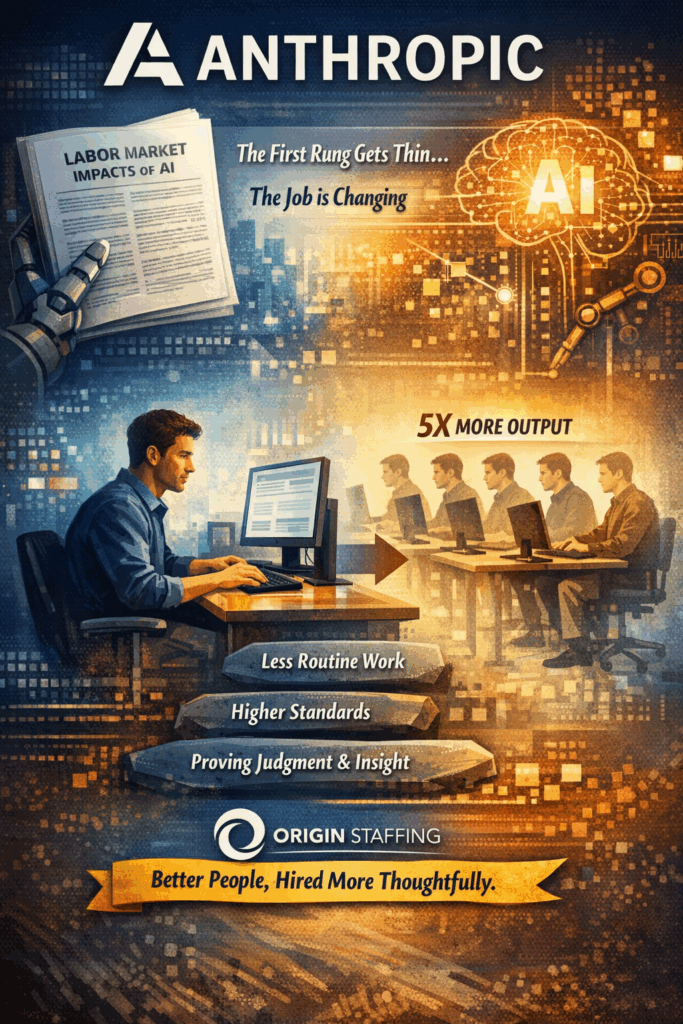
Anthropic job predictions – The First Rung Gets Thin
AI Agentic Automation
Most changes in work do not come with a crash. They come quietly. A little less routine work. Fewer easy first tasks. A higher bar for the person trying to get in.
That is what I took from the new Anthropic report on labor market impacts of artificial intelligence. It is useful because it makes an important distinction that a lot of people skip.
What “exposure” to artificial intelligence actually means
In this report, exposure does not mean a job is gone.
It means more of the tasks inside that job can already be helped by artificial intelligence, or in some cases handled by it, in real work settings. That can be good. It can make people faster. It can cut out repetitive work. It can give strong employees more time for judgment, communication, and decision making.
But it can also create pressure. If the agentic automation platform takes too much of the basic work, the job vertical will become harder to enter. The training ground shrinks. The first rung gets thin and there are long term implications to keep in mind.
The report shows a wide gap between what artificial intelligence could theoretically do and what people are actually using it for today. In computer and math work, the report says the theoretical reach is 94 percent, while observed use today is 33 percent. That is a big gap. It tells us this is not a story of instant replacement. It is a story of uneven change.
The gap is the point. Possible is not the same as happening.
Where the pressure is showing up first
The most exposed jobs in the paper are the ones with a lot of structured language, repeatable analysis, and first draft work. Programmers are near the top. So are customer service representatives and data entry roles. However, its makes programmers 2x, 5x, 10x more effective and they can build more – hence net positive long term for their career vertical. Customer Service & Data Entry will have different implications. I.e., many will be replaced, especially with simple data entry. As Agentic Automation progresses in ability to freely use a computer, the curve will steepen,
What matters for our world is that financial and investment analysts are high on the list too, at about 57 percent.
Financial and investment analysts are already in the higher pressure group.
That makes sense. A lot of analyst work begins with tasks a machine can already touch. Gathering information. Drafting commentary. Building the first version of a report. Turning messy inputs into something clean enough for a manager to review.
But that is not the whole job. Best analysts still have to decide what matters. A great accounting hire still has to read carefully, write clearly, and make a sound call when the answer is not obvious. Strong controls or risk person still has to spot where a process can break and get other people to care. Agentic AI capabilities will certainly enable finance and accounting talent to produce higher quality work product in less time. As they are able to do this, the businesses will have better decision making analysis, better compliance documentation, and simply more insights into the future. This will help the quality companies move faster, expand and grow accordingly.
That is where we think many hiring teams can get confused. They see artificial intelligence getting stronger and assume the answer is fewer people. Often the real answer is better people, hired more thoughtfully. We have written before about that in A Finance Hiring Beyond Titles. When the work changes, strict title matching gets weaker. Proof of judgment gets stronger.
Why the women finding needs context
The report also says the most exposed group is more female, more educated, and higher paid than the group with no exposure. That does not mean women are already being harmed more. It means many of the jobs now feeling the most pressure already have more women in them.
This is about where exposure is concentrated, not a clean verdict on who loses.
That distinction matters. Exposure can mean risk. It can also mean leverage. If a company uses artificial intelligence well – especially agentic automation, the role may become better, faster, and more interesting. If a company uses it badly, it may strip out the training work and leave only the hardest parts, which makes the role tougher to enter and harder to learn. Do present day CFOs understand this? Tbd.
What this means for finance and accounting hiring
The report does not show a broad rise in unemployment for the most exposed workers. That is important.
The quieter signal is slower hiring for younger workers trying to enter the most exposed jobs. That rings true. When routine work gets cheaper, companies often ask fewer junior people to do it. Then they expect the ones they do hire to arrive with better writing, sharper judgment, and more maturity on day one.
For finance and accounting leaders, that changes the scorecard.
Hire for judgment and ownership.
Assess quality of previous career decision making even deeper.
Hire for the ability to carry a messy process from start to finish; for ability to adapt and learn.
Make sure your initial round interviewers (typically HR) understand what you are looking for, otherwise you’ll never even see the talent as their resumes are passed on or they get eliminated in initial rounds since the fit is not perfect, but that is dated thinking in our new age of AI agentic capabilities.
The work is still here. But the easy edge of it is being cut away, and that changes who will do well next.
Happy Hunting & Boldly Forward!
Andrei
Andrei Nikulin – Head of Recruiting – Origin Staffing
Q&A Section
1. What does “exposure” to artificial intelligence actually mean in a finance or accounting role?
It means more of the tasks inside the job can now be sped up, supported, or partly automated. The real hiring question is what remains after that first layer of work gets thinner, and whether your candidate can handle that harder version of the role. Origin Staffing certainly knows how to hunt for these type of candidates.
2. Should hiring managers respond to agentic automation by hiring fewer people?
Not automatically. In many cases, the better move is to hire fewer weak fits and more high judgment operators. The strongest teams are not replacing thinking, they are raising the standard for who gets trusted with it. Involve higher level interviewers in early interview rounds to pitch the strategic vision on the finance function, this gets top performers in the door.
3. What should hiring managers screen for now that more routine work can be automated?
Ask how the person handled a messy close, a technical decision, a weak control, or a conflicting stakeholder set. The best candidates are the ones who can use new tools and still improve the quality of the final answer. Look harder at judgment, writing, ownership, and process leadership. What AI tools are they using in their personal lives?
4. How do you tell whether a candidate actually understands artificial intelligence, rather than just talking about it?
Ask for proof. What did they change, what got faster, what got better, and where did they still need human judgment. It doesn’t have to be at their current job, it may be in their personal lives, since they don’t have direct control over the tools their employer implements. Large companies lag behind in this regard and guard their data. Thus a top candidate looking at new opportunities with companies embracing AI with agentic automation is a very positive signal on fit, as they’ll help champion your roadmap. It doesn’t always matter that they haven’t been able to do it yet in their current role. If their employer was more progressive in this regard and gave them this experience, they likely wouldn’t be looking at new opportunities in the first place, thus you wouldn’t have a chance to hire them. Intent and RFL (Reason for Looking) matters. At Origin Staffing, that is usually where the real signal appears, not in generic claims about being “comfortable with AI.”
5. Why is strict title matching becoming less useful in this market?
Because the work is changing faster than the labels are. Someone coming from public accounting, advisory, internal audit, risk, or transformation may be a better fit for the next version of the role than the person with the neatest title match. A strong search partner should be able to explain that fit in business terms, not just resume terms.
6. What is the risk of cutting too much junior hiring because the basic work is getting automated?
You may save time now and damage your bench later. A lot of early career work used to teach people how the business actually runs, where numbers break, and how decisions get made. Good hiring leaders think about today’s output and tomorrow’s pipeline at the same time.
7. How should finance leaders rethink the financial analyst role in age of AI & agentic automation?
They should stop treating it like a list of tasks and start treating it like an early judgment seat. The best analysts do more than gather information. They frame issues, spot weak assumptions, and help leaders make better decisions. That makes the hiring bar higher, not lower.
8. How can hiring managers avoid screening out the right people too early?
Make sure the first round screen is built around the future of the role, not the old checklist. If the initial reviewers are only looking for a perfect title match, they will often eliminate the strongest adaptable talent before the real decision makers ever meet them. A thoughtful agency can help calibrate that front end of the process.
10. When does it make sense to bring in a firm like Origin Staffing on these searches?
Usually when the role is hard to define, the market is tight, or the best candidate may not be the most obvious one. Origin Staffing knows how to pitch your vision to talent that may not be considering a move into a particular vertical or industry or company size, this is how you get ALPHA in the quality of hire. That is often the difference between filling a seat and making a durable hire that has upside progression. Also, Origin Staffing offers contingent search terms (on non executive level searches) and thus its only upside for a company to compare our talent quality vs. direct applicants. Compare and decide, everything is relative. Cost is zero if you don’t hire our talent at the end of the process.