
Origin Staffing - Thoughts on Recruitment
Jensen Huang Is Back at NVIDIA. It Matters to New England.
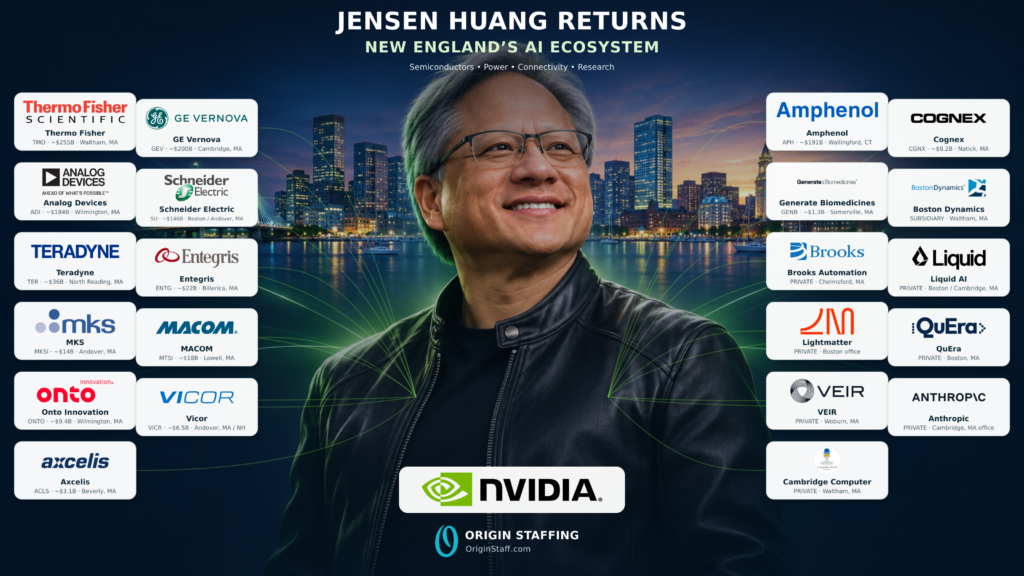
Jensen Huang is back at the helm of NVIDIA, and the market’s reaction was immediate. On November 23, NVIDIA announced that its cofounder had been reinstated as president and CEO. NVIDIA shares were up approximately 31.5% near the end of Monday’s regular trading session, and companies connected to the AI buildout rallied alongside them.
NVIDIA without Jensen Huang is not the same NVIDIA. Since he cofounded the company in 1993, Huang has brought together chips, software, developers, and customers to build a platform for accelerated computing. His ambition has been to give other businesses the tools to develop and deliver AI of their own.
New England is home to companies that test advanced semiconductors, automate the factories that produce them, deliver power to dense computing systems, connect data centers, and use AI in scientific research and robotics. Some work directly with NVIDIA. Others serve the wider industry. Huang’s return is encouraging for these companies because he has been a driving force behind an ecosystem that reaches far beyond NVIDIA itself.
NVIDIA said the board’s independent investigation into the circumstances surrounding Huang’s departure will continue. The company also said its board was confident, based on input from senior U.S. government officials, that his reinstatement posed no national security risk.
How Jensen’s strategy matters to New England
Huang’s approach has been to put powerful AI tools in the hands of more people. That includes the largest technology companies, but also startups, researchers, manufacturers, hospitals, and businesses building their own applications.
One part of that strategy is the development of open AI models. Rather than requiring every company to build a model from the beginning, these models give developers a foundation they can adapt for their own work. At NVIDIA’s GTC conference in March 2026, Huang announced the Nemotron Coalition, bringing AI labs together to develop open frontier models. He called open models “the lifeblood of innovation.”
An open model gives a research team a starting point for a scientific question, while a manufacturer or startup can adapt the technology for a business problem it knows well. That makes AI development possible for organizations that could not build a frontier model themselves. Training, adapting, and running those systems still requires computing power, creating opportunities beyond the model developers.
Huang has also supported the growth of specialized AI cloud providers, often called neoclouds. These companies build computing capacity that customers can rent, giving model developers and businesses another place to access powerful systems alongside the largest cloud platforms. Their customers can run open models as well as other AI workloads.
The effort extends to capital. In January, NVIDIA invested $2 billion in a specialized AI cloud provider. In an August securities filing, NVIDIA described agreements under which selected cloud partners buy its infrastructure while NVIDIA commits to purchase cloud services. The partners can make capacity available to their own customers as demand develops. NVIDIA has also proposed financing platforms with institutional investors to help fund AI infrastructure projects.
This is a business strategy for NVIDIA, and it can widen the market for the companies around it. As more organizations use AI, cloud providers can invest in the chips and facilities needed to serve them. That demand reaches back through the semiconductor supply chain, where companies such as Teradyne, Onto Innovation, and Brooks Automation provide testing, inspection, and automation equipment to chipmakers. At the data center itself, power and connectivity become essential.
The scale of NVIDIA’s AI business
The scale of NVIDIA’s business shows how far this market has come. In its latest reported quarter, ended October 25, 2026, the company reported $115.8 billion in revenue, including $107.6 billion from its data center business. NVIDIA also said its Vera Rubin NVL72 systems had begun shipping.
The Massachusetts companies behind semiconductor manufacturing
Teradyne, based in North Reading, makes equipment used to test semiconductors, memory, and computing systems. Testing matters because an advanced processor must work reliably not just as an individual chip, but as part of a much larger package and computing system. Teradyne reported $1.306 billion in total revenue for the third quarter of 2026, including $1.072 billion from semiconductor test, and said AI demand helped drive record results in memory and integrated systems testing.
In Andover, MKS provides technologies used across semiconductor manufacturing, electronics, and advanced packaging. Its products help customers address challenges involving materials, process control, and increasingly complex device designs. The company reported revenue growth of 54% in its semiconductor market and 43% in electronics and packaging in its latest quarter compared with the prior year. Those figures cover the company’s broader markets, not just AI or NVIDIA.
Onto Innovation, headquartered in Wilmington, focuses on inspection and process control. Its systems help manufacturers measure and inspect increasingly intricate devices and packages. Onto reported quarterly revenue of $409.7 million, up 87.8% from the prior year, and pointed to demand associated with more complex AI and advanced computing architectures.
Entegris, based in Billerica, supplies materials and process solutions to semiconductor manufacturers. As advanced chips generate more heat, materials that help manage that heat become more important. In November, Entegris announced an acquisition and a planned manufacturing investment connected to thermal management materials for advanced AI packaging. The planned manufacturing line is in Taiwan, illustrating how a Massachusetts company can participate in a global supply chain.
Axcelis, based in Beverly, makes ion implantation equipment used in chip fabrication. The company has identified demand for DRAM and high bandwidth memory as an area of strength. High bandwidth memory sits close to advanced processors and helps supply the data that AI workloads need quickly.
In Chelmsford, Brooks Automation supplies precision robots and vacuum automation systems that move wafers through semiconductor manufacturing equipment. Its technology helps keep delicate wafers moving accurately through the production process.
Teradyne’s connection to Huang’s vision also extends into robotics. At COMPUTEX in 2024, Huang highlighted Teradyne Robotics among the companies adopting NVIDIA’s Isaac platform. Teradyne Robotics said it was bringing NVIDIA’s AI and simulation capabilities to its installed base of industrial robots, a way to help customers develop new applications across industries.
The power and connections behind an AI data center
The demand does not stop once a chip is manufactured. A dense AI computing system needs power delivered efficiently, heat removed, and data moved quickly between processors and racks.
Analog Devices, also headquartered in Wilmington, has described its work within NVIDIA’s MGX ecosystem on power protection, conversion, and monitoring. As AI systems use more power, the company is developing technology for the move toward power distribution at 800 volts. That shift is designed to help operators deliver more electricity while managing current, efficiency, and equipment protection.
GE Vernova, headquartered in Cambridge, is working with NVIDIA on power architecture for large AI facilities. An AI data center needs electricity generation, grid connections, transformers, and systems that can deliver power reliably at scale.
Schneider Electric, which has its North American headquarters in Boston and research facilities in Andover, has worked with NVIDIA on reference designs for powering and cooling Vera Rubin systems. Its Massachusetts operations are part of a much larger global business, but the local presence makes the connection especially relevant to this region.
At GTC in March 2026, NVIDIA introduced a Vera Rubin AI factory reference design. The announcement named Schneider Electric as a contributor to the facility design and GE Vernova as a participant in connecting power and grid planning with AI factories. It is a practical example of Huang’s approach: bring computing, energy, and the companies that understand each piece into the same conversation.
Vicor, based in Andover, makes power conversion technology for demanding computing applications. In September, the company said it was purchasing sites in Merrimack and Hooksett, New Hampshire, for planned additional manufacturing capacity. In Woburn, VEIR is developing superconducting power delivery systems for AI data centers and announced a $110 million Series C financing in October. These are different approaches to the same underlying challenge: moving more power where computing systems need it.
Connectivity is another part of the buildout. MACOM, based in Lowell, develops optical and high speed connectivity products used in data center infrastructure. Lightmatter, which has an office in Boston and is headquartered in California, joined NVIDIA’s NVLink Fusion ecosystem to develop optical connectivity products for AI systems. In Connecticut, Amphenol describes its interconnect products as part of the infrastructure surrounding NVIDIA MGX systems.
From infrastructure to research, robotics, and medicine
Across New England, that computing infrastructure is also helping researchers, robotics companies, and life sciences businesses develop new products.
Cambridge Computer, based in Waltham, helps design and integrate computing systems. It was selected to help build the Massachusetts AI Compute Resource at the Massachusetts Green High Performance Computing Center in Holyoke. The shared system includes NVIDIA GPUs and supports researchers from universities across the region.
In Natick, Cognex introduced a machine vision controller powered by NVIDIA Jetson technology. The product is designed to help manufacturers run demanding visual inspection applications directly at the production site. In Waltham, Boston Dynamics has worked with NVIDIA on AI and computing capabilities for its Atlas humanoid robot. Together, they show how computing infrastructure can move from the data center into manufacturing and physical systems.
During his CES presentation in January 2026, Huang highlighted Boston Dynamics and showed how simulation helps engineers train robots for physical tasks.
In life sciences, Thermo Fisher Scientific, based in Waltham, announced a collaboration with NVIDIA on scientific instruments using AI and laboratory automation. In Somerville, Generate Biomedicines uses computational methods to design protein therapeutics. NVIDIA’s venture arm participated in the company’s $273 million Series C financing in 2023.
The region also has companies building AI models and working on the next generation of computing. Liquid AI, with Cambridge roots and a Boston presence, develops efficient foundation models and lists NVIDIA among several silicon partners. Anthropic, the company behind Claude, has expanded its Cambridge presence; NVIDIA has also said Anthropic is accessing its computing capacity through cloud providers.
NVIDIA itself has a quantum research center in Boston. One of its collaborators is QuEra, a Boston company that has worked with NVIDIA on combining quantum hardware and accelerated computing. These are research efforts with a longer time horizon, but they reinforce how much activity around the future of computing already has a New England connection.
How shares moved on November 23, 2026
Shares rose across a wide range of public companies in this ecosystem:
| Company | Ticker | Share price | Change |
|---|---|---|---|
| Analog Devices | ADI | $378.75 | +9.49% |
| Teradyne | TER | $233.51 | +14.03% |
| MKS | MKSI | $205.33 | +11.28% |
| Onto Innovation | ONTO | $190.99 | +12.24% |
| Entegris | ENTG | $142.06 | +14.08% |
| Axcelis | ACLS | $100.50 | +11.35% |
| Vicor | VICR | $142.04 | +13.55% |
| MACOM | MTSI | $231.30 | +18.67% |
| Amphenol | APH | $77.41 | +11.03% |
| GE Vernova | GEV | $756.71 | +8.20% |
| Cognex | CGNX | $48.47 | +9.27% |
| Thermo Fisher Scientific | TMO | $688.08 | +2.77% |
| Generate Biomedicines | GENB | $10.21 | +7.02% |
| Schneider Electric | SU, Paris | €235.85 | +4.11% |
The rally followed a difficult week for AI shares and took place alongside a broader market advance. Still, the range of companies represented here illustrates how far investors see the AI infrastructure cycle reaching.
What this means for companies in the region
For a semiconductor equipment manufacturer, a faster AI buildout can raise questions about production capacity, component availability, manufacturing costs, and how much inventory to carry. For a power company, the financial decisions may center on long construction cycles, capital commitments, and the timing of customer projects. A robotics company may be weighing the cost of bringing a new product into production.
Finance and accounting teams sit close to those decisions. Leaders in FP&A, manufacturing finance, controllership, and operations need to connect spending and hiring plans to customer demand while keeping an eye on margins, cash flow, and execution. Understanding the business well enough to distinguish durable demand from a temporary surge will matter as much as tracking the numbers.
Huang has spent years working to put AI within reach of more organizations. With him back at the helm, New England’s technology, manufacturing, and research companies are well placed to help build what comes next.