
Origin Staffing - Thoughts on Recruitment
Jensen Huang Is Back. Boston and New York Are Financing His AI Vision.
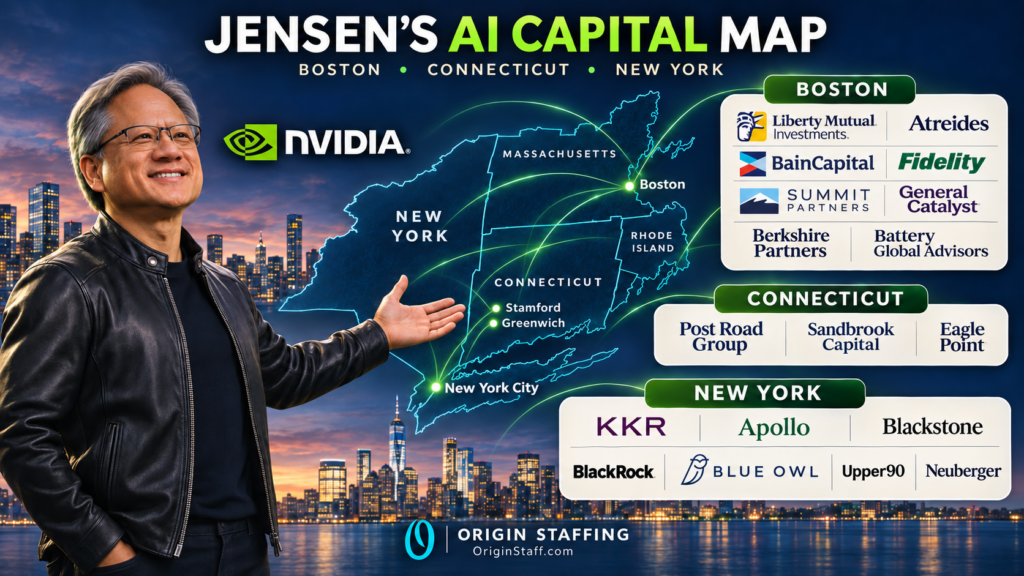
Jensen Huang is back at NVIDIA, and the financial world has a stake in what he does next.
Across Boston, Connecticut and New York, private equity firms, credit investors, venture funds and asset managers are putting capital behind the infrastructure that makes artificial intelligence possible. They are financing data centers and power systems, investing in AI cloud providers and lending against the computing equipment those companies use to serve their customers.
Huang has been central to that opportunity. He has spent years building NVIDIA into a company whose technology can support a growing range of AI models, applications and customers. Just as important, he has worked with the financial industry to make that computing power an asset that long-term investors can finance.
On November 23, NVIDIA announced that Huang had been reinstated as president and CEO. The company said the board’s independent investigation would continue. His return puts him back at the helm as investors are committing capital to a market he has helped build.
Jensen’s strategy matters to people financing AI
NVIDIA systems generate revenue when data centers install and power them, then connect them to customers that need computing capacity.
Huang’s strategy has been to expand the number of people and businesses that can use that capacity. In March, he helped launch the NVIDIA Nemotron Coalition, bringing model developers together to build open AI models that organizations can adapt for their own needs. Huang has argued that open models allow students, scientists, startups and established companies to participate in the growth of AI.
NVIDIA also works with specialized cloud companies, often called neoclouds, that rent access to computing power. Its AI cloud ecosystem includes CoreWeave, Crusoe and other providers serving large technology companies, startups, researchers and businesses developing their own AI applications. More ways to build and use AI can mean more customers for the companies operating the equipment.
That wider customer base matters to investors. A lender evaluating a computing facility wants to understand who will pay for its capacity today and whether the equipment can serve another customer when the first contract ends. NVIDIA’s software, developer ecosystem and support for different workloads help make that question easier to answer, even though the economics depend on each project and its customers.
In August, NVIDIA announced plans to work with six major financial institutions, including Apollo, BlackRock, Blackstone, Goldman Sachs and KKR, on independent financing platforms intended to mobilize more than $500 billion of third-party capital over time. The partnerships were subject to final agreements. The figure describes a long-term goal, not money already raised or deployed.
In an August article on AI infrastructure financing, Huang described his vision for computing as productive infrastructure supported by long-term capital and a diverse customer base. His point is that computing systems can produce an ongoing stream of income for the companies that operate them. That is what gives lenders and investors a reason to finance the equipment, facilities and power behind them.
Boston’s investment firms are already participating
One of the clearest examples is Crusoe, a company that develops AI data centers and operates a specialized cloud platform. Its growth has brought together several Boston investment firms and NVIDIA through different types of financing.
In 2018, Bain Capital Ventures co-led Crusoe’s seed round. The company’s early work centered on the relationship between energy and computing. Crusoe has since expanded into AI infrastructure, combining power, data centers and cloud services.
Boston-based Atreides Management co-led the initial closing of Crusoe’s anticipated $3.9 billion Series F financing in September 2026. NVIDIA participated in the round, and Fidelity Management & Research Company was also listed among the investors. Crusoe announced the round at a $30.9 billion post-money valuation.
Boston’s Liberty Mutual Investments participated in a different part of Crusoe’s financing. In 2025, it joined institutions in an approximately $225 million credit facility led by New York-based Upper90. Crusoe said the money would be used to purchase NVIDIA GPUs and supporting cloud infrastructure. The announcement did not disclose Liberty’s individual commitment.
The Crusoe example brings the pieces together. Venture and growth investors provide equity. Credit investors help finance equipment. NVIDIA supplies technology and has invested in the company. Crusoe uses that infrastructure to provide computing services to customers. Each participant has a different role, but they are all contributing to the same expansion of AI capacity.
Boston’s reach goes beyond Crusoe. Summit Partners led a $100 million growth investment in Runpod, a cloud platform that gives AI developers access to computing for training, fine-tuning and running models. Cambridge-connected General Catalyst co-led an investment in Modal, which helps developers run GPU workloads across cloud infrastructure.
These investments reflect a broader market for computing. An AI company does not need to own a vast data center to build or deploy a product. It can rent the capacity it needs from a provider that has already assembled the equipment, software and infrastructure.
Other Boston firms are investing in the physical infrastructure around that demand. Berkshire Partners has a digital infrastructure strategy that includes data centers and networks. Its investments include MedOne, a data center company in Israel. Battery Global Advisors announced a $208.5 million digital infrastructure fund focused on companies in the data center and digital infrastructure market. Their strategies show how the opportunity reaches beyond direct GPU lending.
Connecticut is helping finance the infrastructure around the chips
The region’s investment activity extends through Connecticut, where firms are backing the power and data center projects that allow computing capacity to come online.
Stamford-based Post Road Group and Boston’s Bain Capital Credit have financed data center operator DC BLOX. In 2024, the firms led an additional equity investment and converted existing debt positions into equity. DC BLOX said the broader financing would support future data center construction and powered land development.
Sandbrook Capital, which has a Stamford office, was an early investor in Cloverleaf Infrastructure. Cloverleaf develops sites with access to power for data centers. In August 2026, NVIDIA made a minority investment in Cloverleaf and announced a strategic partnership with the company. The investment brings NVIDIA into a business that Sandbrook helped back as a developer of the physical sites needed for AI infrastructure.
In Greenwich, Eagle Point Credit Management provided a $137.5 million senior secured facility to an Energy Vault subsidiary. The financing supports the purchase of power generation equipment intended for AI and data center projects. The chips receive much of the attention, but those chips need a reliable source of electricity before they can produce anything.
New York’s investment firms are financing the next phase
The scale of the financing became especially clear on November 20. Apollo and Goldman Sachs announced the pricing of approximately $44 billion of notes to fund NVIDIA Vera Rubin GPUs and related equipment for SpaceX’s computing infrastructure.
Funds or accounts managed by BlackRock and Goldman Sachs Asset Management, along with accounts advised by KKR, provided anchor commitments. Apollo and Goldman led the transaction. The companies said lease schedules were expected to begin after equipment delivery in the first half of 2027.
KKR, which has a growing Boston presence as well as its New York headquarters, has also partnered directly with NVIDIA on the infrastructure around the machines. In June, KKR, NVIDIA and other investors launched Helix Digital Infrastructure with more than $10 billion in capital commitments. Helix is intended to invest in data centers, power and connectivity. NVIDIA is both a founding investor and a strategic technology partner.
Blackstone Credit & Insurance anchored a different type of transaction for CoreWeave. In March 2026, CoreWeave announced an AI infrastructure financing facility of up to $8.5 billion, backed by project assets and an associated customer contract. The facility received investment-grade ratings from Moody’s and DBRS. CoreWeave said approximately $7.5 billion was initially available, with capacity to increase as assets stabilized.
Blue Owl has financed both the equipment and the buildings around it. Funds managed by the firm led a $2.4 billion equipment financing for IREN to support the purchase of NVIDIA Blackwell Ultra systems. Blue Owl’s real assets platform also joined Crusoe in a $15 billion data center joint venture in Texas.
The supporting infrastructure needs capital too. Neuberger Specialty Finance announced a $700 million Crusoe facility secured by power generation equipment for its AI factories. Together with Upper90’s GPU financing for Crusoe, the transaction shows how private credit firms can fund different assets within the same buildout.
These assets are attractive to alternative investment industry lenders
For a lender, the appeal starts with a combination of physical equipment and the income it can produce. A financing may be supported by GPUs and related infrastructure, contracted customer payments, a creditworthy customer, or other protections negotiated for the project.
There is also growing evidence that older NVIDIA systems can remain productive. On NVIDIA’s November 17 earnings call, Colette Kress said some Hopper GPU capacity had been renewed under multiyear agreements at up to twice its original rental rate. She also said B300 rental rates had risen more than 60% since their introduction.
Those figures describe rental rates, not the resale value of every chip. They do show why an investor might see value in equipment that can continue serving customers after its first contract ends. NVIDIA’s large developer base and the ability to run different workloads on its systems support that potential.
The terms still matter. A project backed by a long-term customer contract can look different from one that depends on finding a new customer after a few years. CoreWeave’s August $2.6 billion facility had an approximately five-year maturity, while the underlying customer contracts averaged about three years. Lenders were willing to finance that difference, with the facility priced and rated according to its own structure.
NVIDIA’s role in the financing cycle
NVIDIA sells the systems and invests in companies building AI capacity. In some cases, it also commits to purchase computing services from them.
In January 2026, NVIDIA invested $2 billion in CoreWeave. CoreWeave had separately disclosed an arrangement under which NVIDIA would purchase certain residual unsold computing capacity, subject to the agreement’s terms and service requirements. NVIDIA also supplies CoreWeave with GPUs.
Those relationships can reinforce one another. NVIDIA supports a company building infrastructure for its technology. CoreWeave gains capital and a customer for certain capacity. Other lenders can finance equipment and customer contracts. Businesses using the cloud gain access to computing power that would be difficult to build on their own.
The long-term value depends on customers continuing to use and pay for those services. Strong contracts, productive equipment and well-structured financing can help the parties build that capacity while giving investors a defined way to participate in its growth.
The people behind the capital
The expansion of AI infrastructure is creating work far beyond engineering and construction. Investment firms and the companies they finance need to evaluate customer contracts, model long-term cash flows, account for complex financing structures and understand the value of equipment over time.
That work brings together private credit, investment finance, fund accounting, valuation, treasury, tax, compliance and operational finance. As the market grows, firms will need people who can connect the technology to the financial decisions behind it.
Jensen Huang has spent years bringing those pieces together. His return to NVIDIA gives the investors and companies participating in the buildout a familiar leader at the center of a market that continues to grow.