
Origin Staffing - Thoughts on Recruitment
Tariffs, American Jobs and the Finance Teams Behind the Numbers
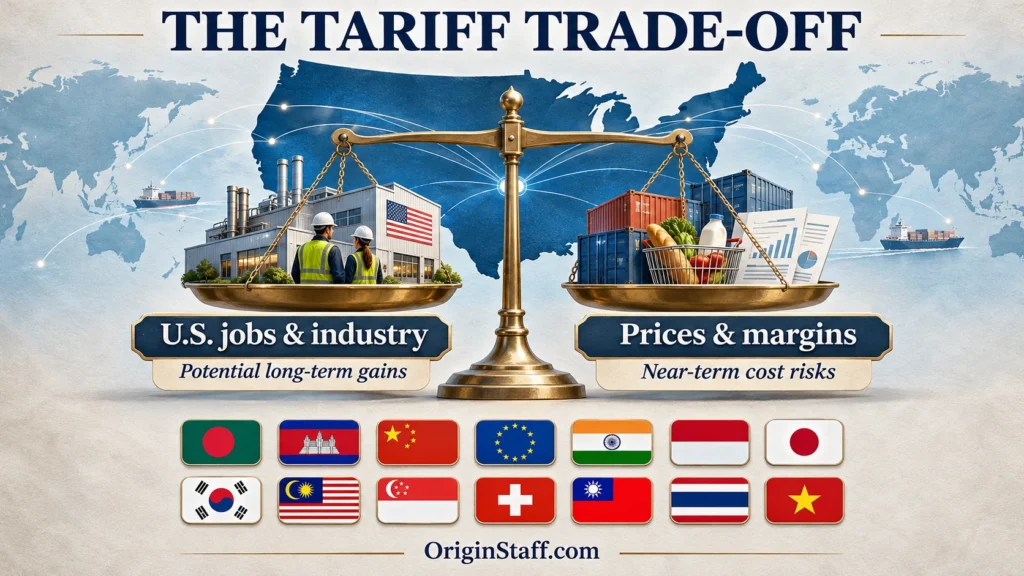
On November 25, the Trump administration proposed new tariffs covering 14 economies in response to manufacturing overcapacity. For Massachusetts businesses, the questions reach from factory competitiveness to pricing, investment and the assumptions behind the CFO’s next earnings call. These are proposals for public comment, with no implementation date established.
At Origin Staffing, we are seeing the importance of this analysis in several current searches for global manufacturers, including public companies. Gross margin has always mattered. Tariff exposure, uncertainty around costs and customers’ willingness to accept higher prices are becoming a more prominent part of the mandate for strategic analysts, finance managers and finance directors.
American jobs sit on both sides of the calculation
USTR’s stated aim is to address subsidies and other practices it says distort competition and weaken American manufacturing. The long-term case deserves consideration: a domestic producer competing against subsidized imports may struggle to justify investment, retain capacity or sustain jobs.
An American manufacturer buying imported components also employs American workers. Higher input costs can make its products less competitive. A U.S. International Trade Commission study of the 2018–2021 period found that earlier tariffs increased production in protected steel and aluminum industries while reducing production in downstream industries using those inputs. The study examined short-term industry effects, not long-term investment or the overall economic benefit of tariffs.
The balance depends on the product, the business and the time horizon. Protection can create room to invest; converting that room into lasting capacity and employment requires execution. Immediate costs can arrive well before any new American factory opens.
Recovering the cost does not necessarily recover the margin
Consider a simplified product selling for $100 with $60 in cost of goods sold: $40 of gross profit and a 40% margin. If an incremental duty adds $5 to that cost, absorbing it reduces the margin to 35%. Raising the price to $105 restores the $40 of profit, but the margin is only 38.1%. Preserving 40% requires a price of about $108.33, assuming unchanged volume and other costs.
That is where price elasticity matters. Will customers accept the increase, buy less or switch suppliers? The answer determines how much of a tariff can be recovered without sacrificing demand.
The November 25 tariff proposals
Proposed, not in force. All 14 economies in the manufacturing-overcapacity action are listed below. The European Union is a bloc. These figures are subject to offsets and product exclusions.
Manufacturing action: reference rates before specified offsets
| Economy / official notice | Principal proposal | Conditional alternative | Principal offsets |
|---|---|---|---|
| Bangladesh | Up to 18% | Up to 20% | Existing 301 |
| Cambodia | Up to 18% | Up to 25% | Existing 301 |
| China | Up to 20%¹ Annex A: up to 10% Annex B: excluded | Up to 40% | Specified China duty¹ |
| European Union | 15% | Up to 20% | MFN + existing 301 |
| India | Up to 25% | 17% | Existing 301 |
| Indonesia | Up to 18% | Up to 25% | Existing 301 |
| Japan | Up to 15% | Up to 20% | MFN + existing 301 |
| South Korea | Up to 15% | Up to 25% | MFN + existing 301 |
| Malaysia | Up to 18% | Up to 25% | Existing 301 |
| Singapore | Up to 20% | 10% | Existing 301 |
| Switzerland | Up to 15% | Up to 20% | MFN + existing 301 |
| Taiwan | Up to 15% | Up to 25%² | MFN + existing 301 |
| Thailand | Up to 18% | Up to 25% | Existing 301 |
| Vietnam | Up to 35% | 20% | Existing 301 |
Higher alternatives depend on USTR finding consultations or commitments inadequate. Lower alternatives for India, Singapore and Vietnam would be considered after qualifying agreements or negotiations.
Rates are before the specified offsets, not current all-in import duties. MFN means ordinary most-favored-nation duties; 301 means existing Section 301 duties.
Product coverage: the 13 non-China notices exclude specified Section 232-covered goods and listed HTS products. Lists and end-use conditions differ. Existing Section 232 duties remain.
1. China: only the specified forced-labor Section 301 duty is credited against the 20% and 40% rates. The 10% clause does not repeat that offset. The 40% alternative says all goods and does not expressly preserve Annex A/B treatment; no general Section 232 exemption is stated.
2. Taiwan: the 25% alternative credits existing Section 301 duties only, without the MFN offset stated for its principal proposal.
14-economy action: comments/hearing requests January 5, 2027; hearings begin January 25. No determination for Mexico or Norway in this batch.
Source: USTR’s November 25 notices and product annexes. Each economy above links to its own notice.
Separate proposal: Brazil aircraft and certain sugar imports
| Origin | Covered goods | Proposed duty |
|---|---|---|
| Brazil | Listed finished aircraft | 10% |
| All origins | Specified high-tier raw cane sugar | +$0.44/kg |
| All origins | Other listed high-tier sugar/syrup entries | +$0.60/kg |
Sugar coverage is all origins, limited to specified high-tier entries. The proposed specific duties replace Brazil’s existing 25% Section 301 component; listed general duties remain. Aircraft: six listed Brazil-origin headings, from 0% to 10% under this action.
Separate action: written comments December 30, 2026; hearing January 14, 2027. No implementation date announced.
Source: Brazil modification notice and exact product codes. This is a separate action from the 14-economy proposal.
Massachusetts filings show how differently tariffs reach earnings
These companywide results and forecasts predate the November 25 proposals, but are relevant considerations:
Watts Water, North Andover. Second-quarter 2026 gross margin fell to 49.0% from 50.6% a year earlier. Management primarily cited acquisition dilution and the previous year’s benefit from tariff-related price increases arriving before the corresponding costs. In the third quarter, Watts received $39.3 million in tariff refunds, plus interest. The refund reduced cost of goods sold because the related inventory had already been sold. Timing matters as much as the headline rate.
Sensata, with its U.S. headquarters in Attleboro. Its July 29 outlook assumed $10 million of third-quarter tariff costs and matching customer pass-through revenue, leaving adjusted operating income unaffected. That was guidance, rather than confirmation that the recovery occurred. It illustrates why revenue, profit dollars and margin percentages need separate explanations.
MKS, Andover. Third-quarter product gross margin, excluding amortization, slipped to 47.1% from 47.3% in the second quarter. Higher tariff and duty costs contributed alongside unfavorable product mix, partly offset by higher volumes. Total gross margin on the same basis nevertheless improved. Attributing the entire 20-basis-point product-margin decline to tariffs would miss the other drivers.
Inflation and credit judgment
Higher import costs can raise prices, but a price-level increase and persistent inflation are different. Federal Reserve Vice Chair Philip Jefferson described that distinction in February, emphasizing the role of inflation expectations. A tariff announcement alone does not tell us where interest rates will go. For a manufacturer, weaker margins or cash tied up in inventory can constrain investment even without a rate increase. Debt maturities, financing terms and customer demand belong in the same forecast.
The hiring mandate from public company finance teams
In our finance searches, these professionals are increasingly the CFO’s eyes and ears. They investigate cost changes, challenge assumptions and help leadership explain what is happening to the business. For public companies, that analysis can support earnings guidance and investor commentary, with accounting, legal and investor relations teams checking how it is presented.
The useful interview conversation goes beyond whether someone has built a gross-margin model. Ask them to trace a cost increase from the imported component through inventory, customer pricing, volume and cash. Then ask what would change their recommendation. Can they distinguish a recurring improvement from a refund? Can they explain a range of outcomes without presenting the most convenient assumption as fact?
That is the judgment these searches call for: understanding the case for stronger American industry while giving executives an honest account of the costs, opportunities and uncertainties in front of them. This Thanksgiving, the people doing that careful work deserve some recognition.