
Origin Staffing - Thoughts on Recruitment
Case Study: Hiring a Corporate Accounting Associate Director in Alternative Investments (Management Company Controllership)

There’s a category of finance hire that looks “standard” from the outside—strong accounting fundamentals, a CPA track record, leadership capability, solid systems exposure—and yet becomes one of the hardest roles a finance organization will fill well.
This case study comes from a recent search Origin Staffing led for a corporate accounting leadership role inside an alternative investments platform: Corporate Accounting, Associate Director – Corporate Controllership Team. The seat lived on the management company side, sat close to senior finance leadership, and required a blend of technical accounting, operational controllership, and stakeholder-facing maturity. (For more on how we run these searches, see Origin Staffing.)
The outcome was strong. The process was demanding. And the lessons are broadly useful to CFOs, Controllers, and Heads of HR who need to hire “operator-leaders” in complex accounting environments—especially when the market is full of candidates who look similar on paper but perform very differently in real operating contexts.
Why This Search Was Difficult (Even With a Strong Brand and Attractive Comp)
Accounting leadership searches in alternative investments often fail for a simple reason: too many candidates have a slice of what’s required, but not the integrated package.
The critical nuance: management company controllership is not fund accounting
Many finance professionals have alternative investments exposure. But that exposure can land in very different operating lanes:
- Fund-side reporting cycles, administrator oversight, and partnership financial statements
- Management company controllership: operational close ownership, corporate reporting, controls/risk, and service to internal stakeholders
- Hybrid “in between” roles that touch corporate elements without owning end-to-end outcomes
For this role, controllership in the management company sense mattered. It required candidates who could execute and improve the “corporate accounting machine,” not only advise on it.
Another nuance: “Big 4 alternative investments” can mean two entirely different things
Alternative investments experience at the Big 4 is often grouped together. In practice, there’s an important split:
- Candidates whose alternative investments experience is primarily fund-side audit work
- Candidates who have meaningful exposure to management company / corporate-side audits and reporting environments
This search required candidates who could translate into corporate controllership quickly—and the management company angle within Big 4 experience became a material differentiator.
The hiring profile was a true “operator-leader”
This wasn’t a narrow technical accounting seat or a pure manager-of-process seat. It was an integrated role with responsibility for:
- Leading controllership outcomes in a high-expectation environment
- Driving process improvement and system evolution (not just tolerating change)
- Partnering effectively across tax, AP, payroll, international teams, and senior stakeholders
- Coaching and developing talent while maintaining a predictable close cadence
That combination is not rare in job descriptions—but it’s rare in candidates who can actually do it.
The Operating Model Matters More Than the Job Description
When companies struggle with controllership hires, it’s often because the hiring team is describing a title, while candidates are interviewing for an operating model.
At Origin Staffing, we treat the operating model as the core spec. A job description can list responsibilities; the operating model reveals the real success criteria and the points of failure.
What we clarify early (and why it changes outcomes)
1) What the controllership team “owns” vs “influences”
In alternative investments firms, accounting and finance responsibilities can be distributed across specialized groups, local/international teams, external providers, and shared services. The difference between owning and influencing changes the profile dramatically.
2) What “service” means internally
In these environments, corporate accounting is often an internal service organization supporting senior executives and business leaders. Hiring teams evaluate whether a candidate can deliver accurate results while maintaining high partnership standards.
3) Where complexity lives
Some environments are complex because of scale. Others because of international structure, entity design, system maturity, or frequent change. Knowing where complexity lives tells you what competencies will actually get stressed on the job.
4) How change is expected to happen
A controllership leader either drives the evolution of process and systems or becomes the bottleneck. The best candidates can speak in concrete terms about how they modernize without destabilizing the close. Thought leadership on this “Six elements of a strong financial close” dynamic is covered well in Deloitte’s article on Optimizing the close process for finance and controllership
These dimensions are what separate “good resume” candidates from “effective operator” candidates.
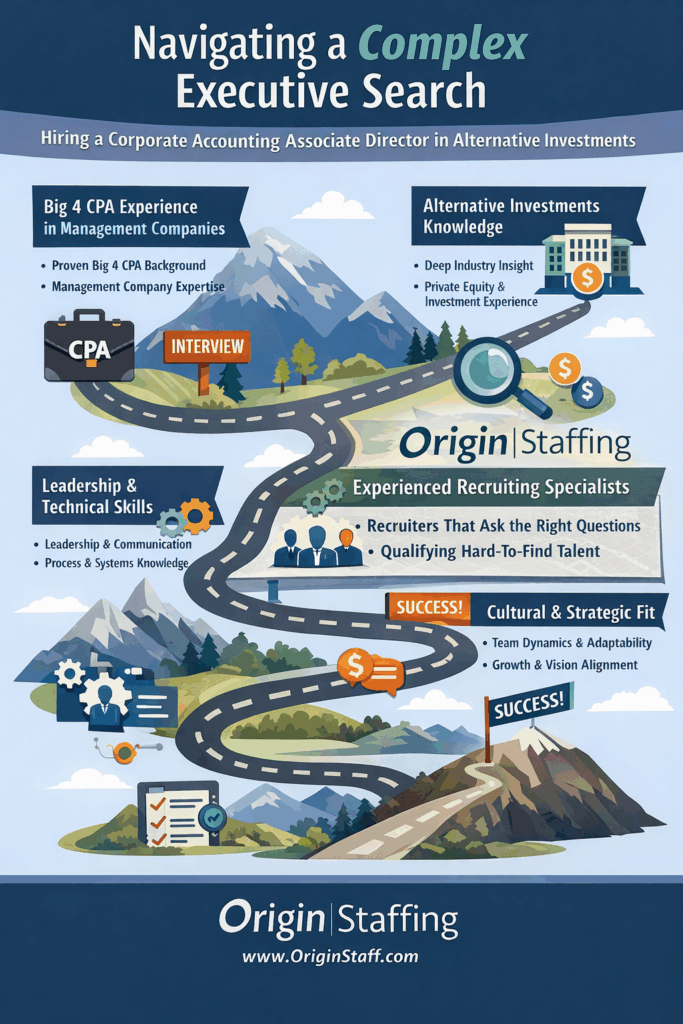
The Intake Call Was the Highest-Leverage Hour of the Entire Search
A thorough intake isn’t a formality—it’s a blueprint for every decision that follows.
For this search, the intake was built to surface the real success criteria, not just the stated requirements. That allowed us to:
- Build a candidate map based on operating model fit
- Screen consistently across a wide market
- Calibrate candidate positioning without over- or under-selling
- Predict what would matter in later interview rounds
- Reduce wasted interviews and preserve hiring team time
What a strong intake produces
A strong intake produces clarity on:
- How the role interacts with the rest of finance (and where friction is likely)
- What “high performance” looks like in the first several months
- Which gaps the team can train versus which gaps will create risk
- What leadership behaviors are required to be effective (not just “nice to have”)
- What the team values culturally in day-to-day collaboration
This is also where we confirm baseline expectations about technical credibility. For CPA-led controllership roles, we tend to align on what “strong” looks like (competence, ethics, and professional standards), and we often reference resources candidates and hiring managers recognize—like the AICPA’s CPA profession and resources hub on Accounting & Financial Reporting.
Intake clarity allowed us to be both selective and fast—two things that usually trade off against each other.
If you’re evaluating recruiting partners and want a sense of how we approach intake and calibration as a firm, you can reach out to book an introductory call with our recruiting team – select “Employer Hiring Need” and tell us about your needs.
Building the Candidate Market Map (How We Broadened Without Diluting)
A common mistake in alternative investments hiring is narrowing the search too quickly to only “direct industry” candidates. Another common mistake is broadening too much and hoping the interview process will sort it out.
We took a middle path: broaden intelligently using a controllership-based lens.
Candidate pools that produced high-signal profiles
1) Big 4 audit leaders with meaningful management company exposure
These candidates often bring the strongest blend of technical rigor, controls discipline, and executive-facing communication. When the management company angle is real (not implied), the translation can be excellent.
2) Industry controllership leaders from complex, multi-entity environments
Candidates coming from corporates with international operations, complex entity structures, or high standards around close and reporting can be highly relevant—even outside alternative investments—if the operating model matches.
3) Alternative investments professionals adjacent to management company operations
Some candidates have deep alternative investments context but have spent most of their time in lanes that aren’t end-to-end corporate controllership. The right ones can be strong if they have demonstrated operational leadership and a credible ramp plan.
The key was matching “experience” to “work content”
In every pool, we screened for evidence of:
- Ownership of controllership outcomes (not just contribution)
- Ability to manage and develop teams
- Comfort operating across stakeholders with competing priorities
- Specific examples of process improvement and system evolution
- Communication that fits a senior environment
This eliminated the “looks relevant” profiles and surfaced the “will work here” profiles.
Evaluation Criteria That Predicted Performance (Without Over-Indexing on Resume Keywords)
Resumes can show where someone worked. They rarely show how someone operates.
For this search, we used a consistent evaluation model built around controllership performance drivers.
What mattered most in evaluation
1) Controllership mindset
Not just “knows accounting,” but demonstrates:
- ownership mentality
- predictability under deadlines
- attention to risk and control
- consistent quality in close execution
2) Leadership behavior under pressure
In high-expectation environments, leadership shows up in:
- how priorities are set
- how feedback is delivered
- how issues are escalated and resolved
- how teams stay aligned when timelines tighten
3) Process improvement credibility
Many candidates say “process improvement.” Fewer can articulate:
- what they improved
- why it mattered
- how they implemented it
- how they ensured sustainability
- the tradeoffs they managed
4) Systems maturity
In controllership roles, systems work is rarely optional. Strong candidates can:
- partner effectively with IT and finance systems owners
- translate business needs into practical requirements
- manage risk during transition
- keep close stable while change happens
In this search, part of the evaluation was whether a candidate could speak concretely about finance system stacks and transformation reality—particularly where platforms like Workday Financial Management – for Asset Management or NetSuite Financial Management might come into play, and what “good” looks like during migration, stabilization, and adoption.
5) Stakeholder partnership
The best controllership leaders communicate like business partners while maintaining technical integrity. They:
- bring solutions, not just problems
- know when to push and when to align
- earn trust across tax, payroll, AP, and senior leadership
6) Technical judgment (practical, not academic)
The evaluation isn’t about quoting guidance; it’s about applying it appropriately and documenting conclusions. Many teams rely on the FASB Accounting Standards Codification overview as the shared baseline reference point for U.S. GAAP research and structure.
Why Detailed Feedback After Each Round Was a Strategic Advantage
In multi-round searches, the biggest hidden lever is the feedback loop.
When feedback is shallow, the process becomes repetitive: interviews occur, impressions are formed, and decisions drift. When feedback is detailed and structured, each round increases signal quality and reduces uncertainty.
What structured feedback unlocked in this search
- Faster calibration of what the team was responding to in real time
- Sharper candidate coaching focused on communication clarity, alignment, and operating style
- Better prediction of who would perform well in later rounds
- Cleaner decision-making when finalists were close
This is a major reason agencies can add value beyond sourcing: the best firms treat the interview process as a data stream and convert it into actionable improvements round by round.
The Final Decision: What Separates “Finalist” From “Hire”
In many searches, several candidates can meet the technical bar. The difference between “finalist” and “hire” typically shows up in leadership maturity and fit for the specific environment.
Measured confidence beats high intensity
Candidates who performed best were confident without overselling certainty. They signaled:
- respect for the complexity of the environment
- a realistic view of what the transition requires
- thoughtful pacing in communication
- comfort learning quickly without appearing casual about the work
In senior controllership roles, executive teams often choose the leader who feels dependable under pressure—not just impressive on paper.
Durable motivation matters
At the final stage, leadership wants to know:
- Why this role now?
- Why this environment?
- Why will this person stay and grow here?
Candidates with clear, durable motivation—tied to the work content and operating model—tend to win. Candidates who frame the move as a generic “step out of public” tend to lose.
What Companies Should Take From This Case Study
If you are considering using an agency for a corporate accounting leadership hire in alternative investments, these are the practical takeaways:
- Prioritize intake depth over speed
The fastest way to slow down a search is to start it without clarity. A strong intake is what produces speed later. - Define the operating model, not the title
Two roles with the same title can require completely different profiles. Define ownership, stakeholders, and change expectations explicitly. - Don’t treat alternative investments experience as a single category
Be precise about what kind of exposure is relevant—fund-side vs management company vs hybrid—and what the day-to-day work actually resembles. - Insist on a structured feedback loop
Each interview round should increase clarity, not just consume time. Detailed debriefs are one of the most effective predictors of a successful hire. - Evaluate maturity and self-awareness as seriously as technical skill
Technical skill gets candidates to finalist status. Maturity and operating fit usually decide the hire.
How Origin Staffing Approaches Searches Like This
Origin Staffing is built for roles where the cost of a miss is high: controllership leadership, finance transformation, technical accounting + operational ownership, and high-expectation environments where the hire must elevate the team.
Our approach emphasizes:
- intake that defines the operating system behind the role
- a candidate map built around controllership fit, not keyword matching
- consistent evaluation criteria across multiple candidate pools
- detailed feedback loops that improve outcomes round by round
- disciplined candidate prep focused on clarity, maturity, and authentic value
If you’re hiring a corporate accounting leader inside alternative investments—or any complex finance environment—this is the difference between running a process and running a search.
If it’s helpful to talk through a current hire, you can reach us via Contact, and follow updates on our LinkedIn company page.
This search was led by Andrei Nikulin – Head of Recruiting at Origin Staffing