Origin Staffing - Thoughts on Recruitment
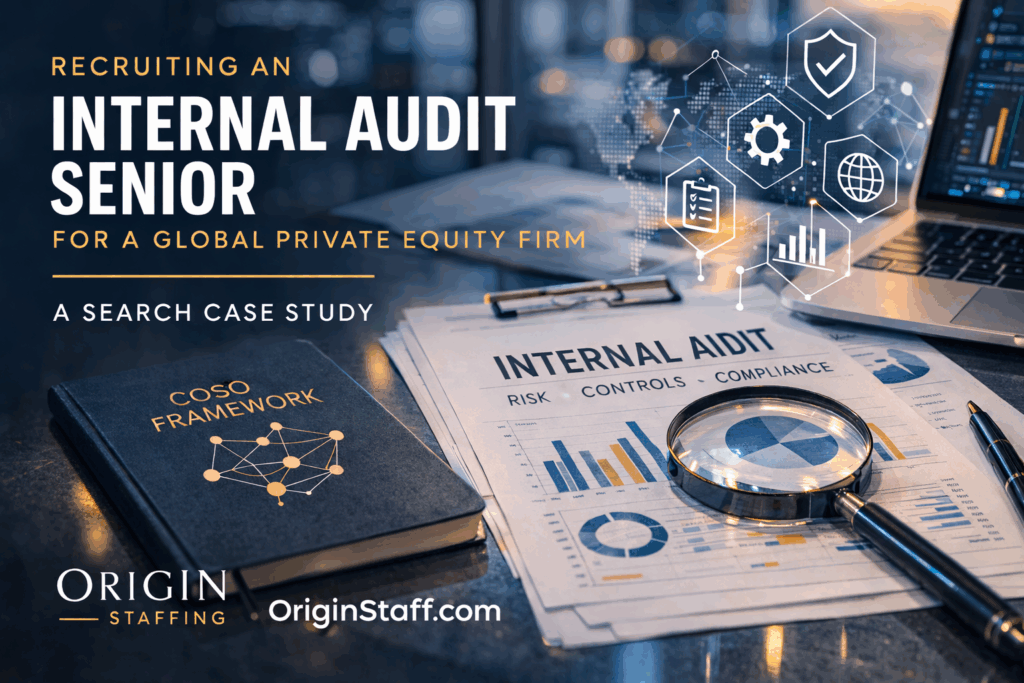
Recruiting an Internal Audit Senior for a Global Private Equity Firm | A Search Case Study
Executive Summary
Origin Staffing partnered with a leading global private equity firm to fill an Internal Audit Senior position supporting the firm’s growing internal audit program.
The hire was driven by rapid organizational growth and the need to expand internal audit coverage across an increasingly complex investment platform.
The client initially prioritized candidates with direct financial services internal audit experience, typically from Big 4 audit or advisory practices.
However, the internal audit and SOX talent market has become increasingly constrained, with many professionals seeking to exit the field rather than deepen their careers within it.
Origin Staffing ultimately identified a candidate whose experience came from a different sector but demonstrated a strong internal audit mindset grounded in core frameworks such as COSO and risk-based audit methodology.
Through targeted preparation and technical alignment, the candidate successfully demonstrated that effective internal audit professionals translate their methodology across industries.
The search closed in approximately one month from kickoff to accepted offer, resulting in a critical hire for the client’s growing Internal Audit and Compliance function.
Role Context and Why This Hire Mattered
This was a growth hire within the client’s Internal Audit and Compliance organization.
At the time of the search, the function operated with a lean structure where a single Director was responsible for managing nearly every component of the internal audit process, including:
• Audit planning
• Audit execution
• Workpaper development
• Executive reporting
• Regulatory oversight
For a global investment platform operating across multiple asset classes, this structure created scalability challenges as the organization continued to expand.
The Internal Audit Senior role was designed to strengthen the foundation of the internal audit program by adding capacity in three key areas:
• Risk-based audit execution
• Internal controls evaluation
• Compliance monitoring across global operations
This hire would help support the continued development of a robust internal audit program capable of scaling alongside the firm’s investment platform.
Why This Search Was Hard
Internal audit and SOX compliance roles present unique recruiting challenges.
Unlike many finance roles where professionals actively seek advancement within the same discipline, the internal audit market often experiences the opposite dynamic. Many professionals enter the field to gain exposure to business operations and then pursue transitions into other finance functions.
As a result, the pool of professionals who both possess internal audit expertise and want to continue developing within the field can be relatively limited.
Additionally, the client historically preferred candidates with either:
• Big 4 financial services audit experience
• Internal audit experience within asset management or financial services
While understandable given the regulatory complexity of the industry, this preference significantly narrowed the candidate pool.
Origin recognized early in the process that focusing exclusively on financial services backgrounds could cause the client to overlook candidates with strong internal audit methodology and analytical thinking.
Market Mapping – Candidate Profiles Considered
Origin Staffing evaluated candidates from several backgrounds during the search.
These included:
• Big 4 Risk Advisory professionals with financial services clients
• Internal auditors working within asset management firms
• SOX specialists within consulting and advisory firms
• Risk advisory consultants with internal controls experience
Many candidates fell into two common categories.
The first group possessed industry experience but approached internal audit work primarily through standardized workpaper execution. Their processes often relied heavily on rolling forward prior-year documentation rather than reassessing whether the underlying control environment had materially changed.
The second group demonstrated strong analytical ability but expressed little interest in continuing within internal audit functions long term.
The eventual hire stood out because he demonstrated a genuine ability to apply internal audit methodology rather than simply execute a checklist.
Technical Depth – Internal Audit Mindset vs Industry Experience
One of the most important insights from this search was that strong internal audit professionals rely on consistent frameworks regardless of industry.
Frameworks such as the COSO Internal Control – Integrated Framework provide a structured methodology for evaluating risk and internal controls across organizations. Originally developed to improve confidence in financial reporting and internal control environments, the COSO framework has become the most widely used internal control model in the United States and globally.
The framework helps organizations design, implement, and evaluate internal control systems that support operational, reporting, and compliance objectives.
At its core, COSO organizes internal control around five integrated components:
• Control Environment
• Risk Assessment
• Control Activities
• Information and Communication
• Monitoring Activities
Together, these components create a system for identifying risks, designing controls, evaluating effectiveness, and continuously improving processes.
Because COSO is intentionally industry-agnostic, strong internal auditors focus less on memorizing specific controls within one industry and more on understanding how to evaluate risk holistically.
The most effective auditors approach engagements with questions such as:
• What could go wrong in this process?
• What is the potential impact if a breakdown occurs?
• Which risks are most material to the organization?
• Are existing controls actually mitigating those risks?
This mindset allows auditors to translate their skill set across industries with relatively minimal adjustment.
During the interview process, the candidate successfully demonstrated this broader perspective by focusing on internal audit strategy and risk evaluation rather than simply discussing the specific controls he had previously tested.
Instead of emphasizing narrow control execution, he spoke about:
• Performing top-down risk assessments
• Identifying root causes of control deficiencies
• Focusing audit coverage on the most material areas
This approach resonated strongly with the client’s leadership team and reinforced a key takeaway from the search:
The best internal audit professionals are not defined by the industry they previously worked in. They are defined by their ability to apply consistent risk and control frameworks to new environments.
Interview Process
The interview process consisted of two primary rounds.
The first round involved virtual discussions with senior leaders within the Compliance organization, including the Chief Compliance Officer and the Internal Audit Director. These conversations focused on the candidate’s approach to risk assessments, internal control evaluation, and communication of audit findings.
The second round took place in person and included meetings with several members of the broader Compliance leadership team.
These discussions emphasized the candidate’s ability to collaborate with stakeholders, communicate complex concepts clearly, and approach internal audit work with a thoughtful and analytical mindset.
Because internal audit professionals frequently work with operational teams that may not be deeply familiar with audit frameworks, communication skills were considered especially important.
The candidate’s ability to translate technical internal control concepts into practical business language became a key differentiator throughout the interview process.
Offer Design and Closing
Although the candidate was exploring multiple opportunities at the time, the client ultimately stood out for several reasons.
First, the organization offered the opportunity to contribute meaningfully to the development of an expanding internal audit program within one of the most respected investment firms in the industry.
Second, the role provided exposure to a broad investment platform spanning private equity, credit, venture capital, and real assets.
Finally, the leadership team communicated a clear vision for how the internal audit function would evolve as the organization continued to grow.
This combination of platform prestige, career development opportunity, and intellectual challenge made the role particularly compelling.
The candidate accepted the offer and began the position within 2 months of his initial interview.
What Hiring Managers Can Learn From This Search
This search highlighted several lessons for organizations hiring internal audit professionals.
Industry experience should not be viewed as the sole indicator of success in internal audit roles.
Professionals who understand core audit frameworks and risk-based methodology often adapt quickly to new industries.
Organizations should also evaluate whether candidates approach internal audit work with curiosity and analytical ownership rather than simply executing standardized procedures.
Finally, communication ability and the capacity to explain internal control concepts to non-audit stakeholders are often just as important as technical knowledge.
Companies that recognize these traits are better positioned to build internal audit teams capable of delivering meaningful insight rather than procedural compliance.
FAQ
Why are internal audit roles difficult to recruit for?
Many professionals view internal audit as a stepping stone into other finance roles. As a result, experienced internal auditors are often difficult to retain within the field.
Is relevant industry experience required for internal audit roles?
While industry familiarity can help accelerate onboarding, strong internal audit professionals rely on frameworks such as COSO that apply across industries.
What qualities make a strong internal auditor?
Strong internal auditors demonstrate analytical curiosity, risk awareness, communication skills, and the ability to evaluate the broader control environment.
Why do private equity firms invest heavily in internal audit programs?
Private equity firms operate across multiple portfolio companies and regulatory environments, requiring robust internal control frameworks and risk monitoring.
Work with Origin Staffing
If it’s helpful to talk through a current hire, you can reach us via Contact Us, and follow updates on the Origin Staffing LinkedIn company page.
This search was led by Brian Henry – Recruiting Manager, and Andrei Nikulin – Head of Recruiting at Origin Staffing.