
Origin Staffing - Thoughts on Recruitment
Hiring compliance talent for the SEC Marketing Rule: What Actually Matters

A Compliance Search Case Study (Investment Management)
Executive Summary
Origin Staffing was retained to support SEC Marketing compliance hiring responsible for reviewing marketing and advertising materials under the SEC Investment Adviser Marketing Rule (Rule 206(4)-1) for a mid-sized U.S. investment manager with both public and private strategies.
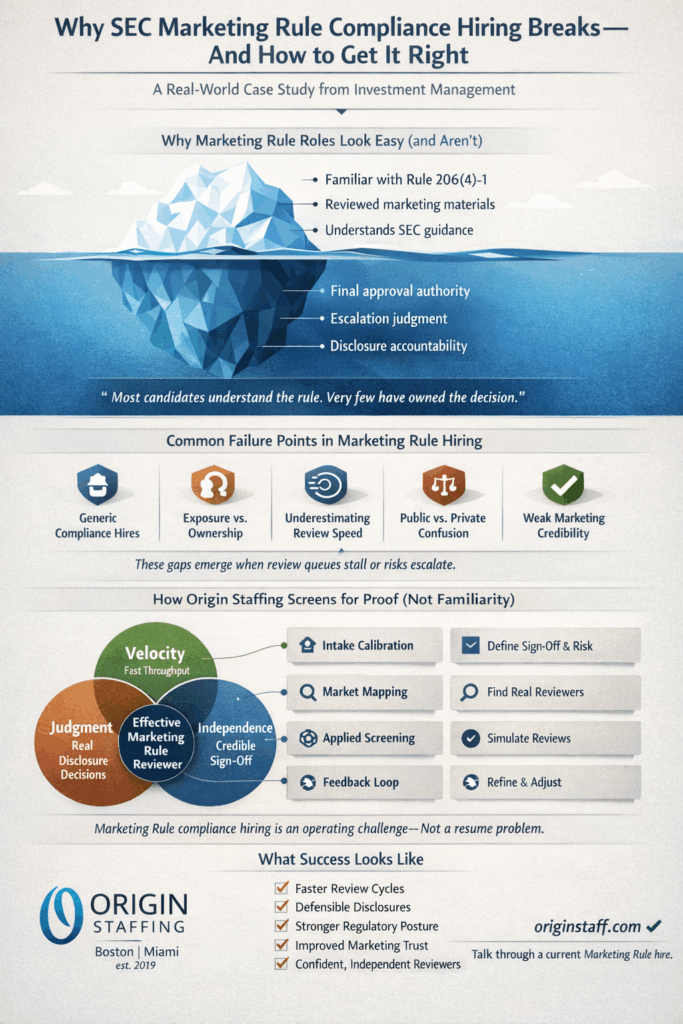
Although the role appeared straightforward on paper, the search proved structurally difficult. The candidate market is crowded with professionals who understand the language of the rule, but thin when it comes to individuals who have owned final review authority, applied regulatory judgment under time pressure, and managed real marketing throughput.
The hiring firm required more than policy familiarity. Success depended on independent approval authority, applied disclosure judgment, and credibility with marketing stakeholders operating at speed.
Origin Staffing differentiated the search through deep intake calibration, market mapping based on operating reality, and applied screening designed to surface proof of ownership rather than theoretical knowledge. The search concluded with a hire aligned to the firm’s review volume, risk posture, and long-term compliance maturity.
Why This Role Mattered
SEC Marketing compliance hiring in investment management has changed materially since the SEC’s adoption of the Marketing Rule. What was once a largely documentation-oriented function is now a front-line risk control tied directly to brand credibility, regulatory posture, and go-to-market execution. The Marketing Rule is constantly evolving and recent 2026 updates are summarized here.
For this firm, marketing materials spanned both public and private strategies, each with different disclosure requirements, substantiation standards, and escalation risks. Review decisions had real commercial impact:
- Delays slowed distribution
- Inconsistent judgment increased regulatory exposure
- Weak escalation eroded internal trust
The role sat at the intersection of Compliance, Legal, Marketing, and HR. The successful hire needed to operate as an independent reviewer, not a passive gatekeeper — capable of moving quickly while applying defensible regulatory judgment in ambiguous scenarios.
Why the Search Was Structurally Hard
Marketing Rule review is not general compliance
Many compliance professionals understand Rule 206(4)-1 conceptually. Far fewer have owned a marketing review queue with real approval authority. This distinction is reinforced by the SEC Division of Examinations’ ongoing focus on advertising practices and disclosure controls.
(See: U.S. Securities and Exchange Commission – Division of Examinations risk alerts and SEC Risk Alert: Marketing Rule Compliance Takeaways.)
Velocity plus judgment is rare
The environment required sustained throughput without sacrificing rigor. Candidates who could cite guidance but struggled with prioritization, escalation, or review volume were screened out early.
Public and private strategies create real complexity
Disclosure standards differ meaningfully across strategy types. Experience confined to one side often failed to translate cleanly.
False positives dominate the market
Resumes frequently referenced “marketing exposure” without evidence of final sign-off responsibility or escalation ownership.
Stakeholder tension is unavoidable
The role required credibility with marketing partners while maintaining independence. Candidates uncomfortable with that tension did not progress.
Boutique operating models raise the bar
With fewer layers, there was no buffer for indecision. The hire needed to operate autonomously from day one.
Intake and Calibration: Turning a Job Description into an Operating Scorecard
Origin Staffing treated intake as the highest-leverage phase of the search. Rather than rely on a generic job description, we focused on how the role actually functioned — and where it would break under pressure.
Key calibration questions included:
- What materials the role approves vs. advises on
- Where final sign-off authority lives
- How disagreements with Marketing are resolved
- What constitutes acceptable internal risk
- Expected review volume and turnaround pressure
- How success is measured after 90 days
This intake-first approach reflects how Origin Staffing executes complex searches across compliance, accounting, and finance functions.
Market Mapping: Where We Looked — and Why
First, Origin Staffing mapped the market across multiple candidate ecosystems while maintaining strict screening discipline.
Candidate pools explored
- Compliance teams at larger asset managers with centralized review functions
- Smaller RIAs where reviewers owned end-to-end approval
- Hybrid roles bridging Compliance and Marketing with documented authority
Profiles intentionally screened out
- Policy-only compliance roles
- Advisory-only marketing support functions
- Candidates without SEC-registered adviser exposure
This approach broadened the search intelligently without diluting quality, a common failure point in marketing compliance hiring.
Screening for Proof-of-Fit
Next, resumes alone could not distinguish between surface familiarity and real capability. Origin Staffing validated depth through applied screening prompts tied directly to the operating model.
Examples included:
- Walk through a marketing review that required material disclosure revisions
- How do you evaluate performance-related statements under the rule?
- What triggers escalation, and how is it documented?
- How do you substantiate claims and retain audit-ready records?
- Where do reviewers most commonly misapply the rule?
- How do you balance speed vs. risk during peak volume periods?
Only candidates who demonstrated concrete ownership advanced.
Shortlist Profiles: Understanding the Tradeoffs
To support decision-making, Origin Staffing presented anonymized finalist archetypes rather than generic resumes.
- Profile A: Strong technical knowledge, slower velocity under pressure
- Profile B: High throughput, inconsistent escalation instincts
- Profile C: Balanced judgment and velocity, clear ownership mindset, strong stakeholder credibility
Profile C aligned best with the firm’s operating reality.
Interview Feedback Loop and Offer Close
Finally, structured feedback after each round refined the profile in real time. Early interviews emphasized rule familiarity. Mid-round feedback elevated judgment and independence. Final discussions focused on trust, tone, and credibility.
Offer discussions centered on scope clarity, leveling confidence, and long-term fit rather than transactional mechanics.
What Firms Can Learn From This Search
- SEC Marketing compliance hiring fails when hired as generic compliance positions
- Velocity is a competency, not just a workload issue
- Review ownership matters more than policy familiarity
- Deep intake prevents downstream misalignment
- Structured feedback loops shorten time-to-hire and improve outcomes
Frequently Asked Questions
Why is Marketing Rule hiring difficult?
Because it requires regulatory judgment, review volume management, and stakeholder credibility — a narrow overlap.
How is marketing review different from general compliance?
It requires independent approval authority and applied judgment, not advisory support alone.
What backgrounds translate best?
Candidates with documented review ownership inside SEC-registered advisers.
How long do these searches take?
Timelines vary, but clarity at intake materially reduces duration.
What mistakes do firms make most often?
Hiring for familiarity rather than demonstrated ownership.
Call to Action
If it’s helpful to talk through a current marketing compliance hire, you can connect with Origin Staffing at:
This search was led by Jared Weber, Associate Director of Recruiting at Origin Staffing: