
Origin Staffing - Thoughts on Recruitment
Beyond Title Matching: Inside a Property Accounting Search Case Study
Executive Summary
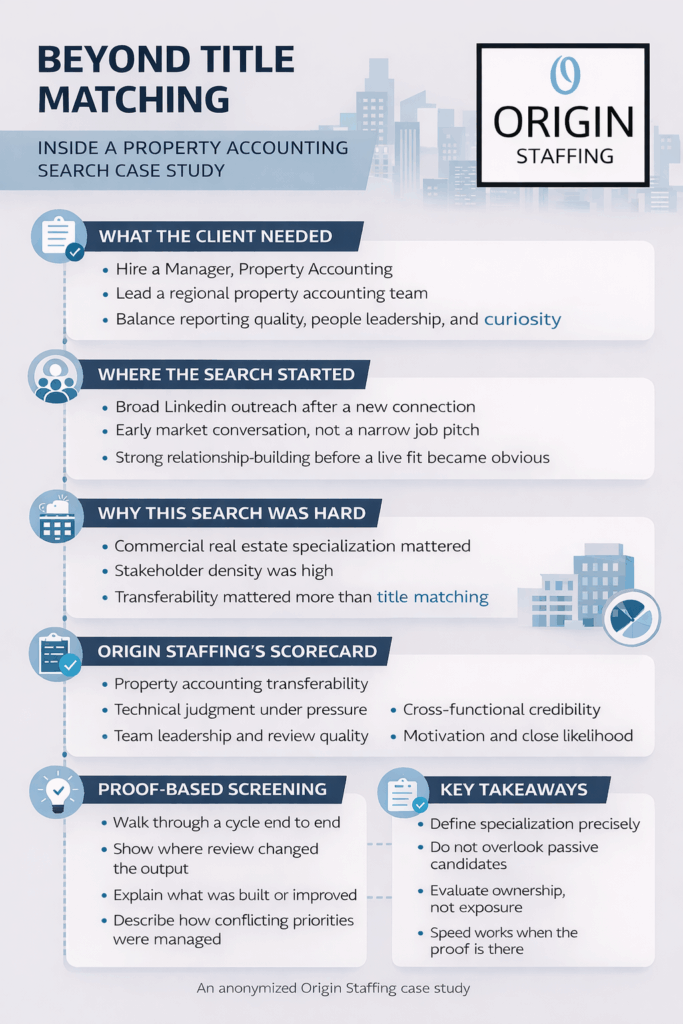
This anonymized search case study shows how Origin Staffing placed a manager-level candidate into a commercial real estate property accounting leadership role that was more complex than the title first suggested.
At a glance, the search looked familiar. The client needed a technically strong accounting leader with management capability, real estate exposure, and enough maturity to move from public accounting into industry. But once the role was unpacked, it became clear that this was not a generic accounting manager search. The hire would need to oversee a regional property accounting function, review GAAP financial statements and supporting workpapers, manage recurring close and reporting cycles, support controls and audit activity, coordinate with multiple internal partners, and step into the work directly when deadlines tightened.
That combination changed the search.
The real question was never whether a candidate had touched real estate. The real question was whether the candidate’s version of real estate experience would translate into the operating reality of a Manager, Property Accounting seat where accountability sits in the middle of people, process, systems, and deadlines.
This search reinforced four repeatable lessons. First, specialization matters. Second, public accounting remains one of the best talent pools for real estate accounting hiring when the experience is truly transferable. Third, passive candidates often become the strongest candidates because they are open before they are active. Fourth, speed works only when it is supported by proof, not assumptions.
What the Client Needed
The client needed a Manager, Property Accounting who could lead a regional group of property accountants across a commercial real estate portfolio and raise the quality of output without slowing the business down.
That sounds straightforward until the work is mapped properly.
Success in this role meant reviewing financial statements, budgets, billings, and supporting schedules with enough technical rigor to catch issues before they became reporting problems. It meant keeping monthly, quarterly, and annual close calendars on track. It meant staying aligned with debt-compliance requirements, supporting SOX-related walkthroughs and testing, helping improve procedures inside the department, and presenting results to senior management in a way that was both accurate and useful.
It also meant leading people. This was not a narrow individual-contributor role dressed up as management. The hire needed to manage workload distribution, develop staff, create quality standards, support training, and still remain close enough to the work to step in when deadlines, coverage gaps, or heavier-than-usual periods required direct involvement.
That mix made the opportunity attractive to the right candidate. It offered visible ownership, broader leadership scope, and a stronger operating seat inside the business. For someone coming from public accounting, it represented more than an exit. It represented a move into direct accountability and a clearer line between judgment and outcome.
Why This Search Was Hard
Three complexity drivers made this search harder than a standard accounting management hire.
First, the role required specialization inside specialization. Commercial real estate is not one interchangeable category. Office, retail, industrial, and ground-lease environments create different rhythms, reporting needs, operational touchpoints, and expectations around the quality and timing of information. A candidate can be strong in real estate broadly and still not be the best fit for a specific portfolio context.
Second, the role sat in a dense stakeholder environment. Property Accounting needed to coordinate closely with Corporate Accounting, Lease Administration, Systems Management, Property Management, and senior leadership. That means this role was never just about debits, credits, and close checklists. It was about handoffs, escalation paths, dependency management, and keeping accountability with the accounting function even when inputs came from multiple teams.
Third, the role required transferability, not just familiarity. Plenty of candidates can describe accounting work in real estate. Fewer can show they are ready to move from public accounting into a management seat that requires direct ownership, team leadership, and cross-functional judgment inside a live operating platform.
That is exactly where Origin Staffing’s accounting recruiting expertise and finance recruiting expertise matter. This search could not be run as a title match. It had to be run as an operating-reality evaluation.
Where the Search Actually Started
This placement did not begin with a narrowly targeted outreach tied to one live property accounting opening. It began with a broad LinkedIn follow-up after a new connection.
That matters because it reflects how many strong searches actually start.
The first message was intentionally broad. Rather than forcing one specific title too early, the outreach opened a market conversation around accounting and finance roles across several paths that often appeal to public accounting talent considering a move. That approach worked because the candidate was not yet reacting to one job description. The candidate was reacting to a recruiter who understood the transition questions that usually come before the first serious interview process.
That early positioning mattered later. Once the right property accounting opportunity appeared, there was already enough context to explain why the move made sense. The story was not, “Here is a job opening.” The story was, “Here is a role that matches the kind of move you may already be ready to make.”
That distinction is important. Great searches are not always won by targeting only active applicants for one specific role. They are often won by building the right relationships early, understanding how public accounting candidates think about career paths, and recognizing when a broad conversation becomes a highly specific fit.
That is one reason our jobs page is only one piece of the search process. Strong placements often begin before a candidate ever acts like an applicant.
Origin Staffing’s Methodology: Scorecard + Proof-Based Screening
Origin Staffing ran this search through a scorecard and proof-based screen because this role could not be evaluated responsibly through resume keywords alone.
The Origin Staffing scorecard
- Transferability into commercial property accounting
- GAAP judgment under close and reporting pressure
- Ability to review and elevate the work of Staff and Senior Accountants
- Team leadership, coaching, and workload management
- Readiness to move from client service into internal ownership
- Credibility with senior leadership and cross-functional partners
- Comfort with controls, debt-compliance reporting, and audit support
- Willingness to step in hands-on during heavier periods
- Motivation alignment, transition logic, and likelihood to close
This matters because a search like this is usually won or lost in the gray areas. The candidate does not need to have held the exact same title in the exact same environment before. The candidate does need to show that the underlying building blocks are strong enough to carry the transition.
The proof prompts that mattered
- Walk me through a reporting cycle end to end. Where did judgment matter most?
- Show me where your review changed the quality of the final deliverable.
- What did you build, improve, or standardize as your responsibilities grew?
- How did you manage conflicting priorities across deadlines, staff needs, and stakeholder requests?
- Where does your background translate most directly to property accounting leadership, and where would the learning curve be steepest?
- Tell me about a time you had to keep quality high while also covering for bandwidth or process disruption.
Those questions force ownership language. Strong candidates talk about what they built, led, resolved, and delivered. Weaker matches stay in the language of exposure.
Stakeholder Ecosystem, Dependencies, and Handoffs
This role lived in the middle of a real accounting ecosystem, which is one reason it was attractive and one reason it was hard.
Lease Administration influences treatment and billing logic. Systems Management affects how cleanly information moves and how much friction the team inherits. Property Management influences timing, operating detail, and issue escalation. Corporate Accounting needs consistent close discipline and reporting quality. Senior leadership needs accurate operating results and useful explanation, not just technically correct numbers. Auditors and lenders can add external deadlines and documentation pressure on top of everything else.
That is why accountability could not be outsourced. Other teams own inputs, but Property Accounting still owns the output. The right hire needed to manage handoffs well without hiding behind them.
The Change Opportunity Inside the Role
This search also had a meaningful change component, even if it was not labeled as a transformation hire.
The role called for someone who could improve procedures inside the department and improve how Accounting interacted with other functions. That is real value creation. In practice, that means tightening review standards, making close cycles cleaner, reducing noise in cross-functional handoffs, creating better training, and helping the team move from reactive execution toward a more reliable operating rhythm.
That work is difficult for the right reasons. Process improvement in accounting is rarely glamorous. It requires discipline, consistency, credibility with stakeholders, and enough technical confidence to change what is not working without destabilizing what is. But for the right candidate, it is also one of the most attractive parts of the opportunity because it compounds. Better systems thinking, better process ownership, and better cross-functional leadership tend to create outsized career value over time.
Candidates exploring similar moves often benefit from Origin Staffing’s interview preparation resources before the process becomes formal.
Why the Candidate Was Credible
The candidate who ultimately landed the role was not simply a clean title match. The candidate was a strong transferability match.
The profile brought a blend of real estate accounting pattern recognition, technical accounting maturity, leadership progression, and enough management presence to make the move believable. That mattered more than a perfect one-for-one resume mirror.
This is an important hiring lesson. Many firms overcorrect toward the narrowest possible background and miss candidates whose experience is more portable than it first appears. In this search, the winning profile made sense because the foundational ingredients were already there. Origin Staffing’s job was to separate what was essential from what was merely familiar and then position the move accordingly.
That is also why Origin Staffing’s search case studies tend to emphasize market logic and evaluation method rather than just celebrating the outcome. The process itself is part of the value.
Process Momentum and Close
Once the fit became clear, speed helped.
That speed worked because the process was grounded in proof. The search moved faster once the transition case made sense, the candidate understood the real value of the role, and the client had a clearer view of why the match was stronger than a surface-level title comparison would suggest.
The close still required calibration. As with many accounting and finance searches, the final decision was not only about compensation. It was about risk, growth, scope, and confidence in the move. The candidate needed to see the opportunity as a career-building step, not just a lateral change. The client needed conviction that the candidate could translate quickly enough into the role’s real operating demands.
That is where disciplined search work matters most. Offers do not close because everyone is excited. They close because the reasoning stays coherent from first conversation through final decision.
What Hiring Teams and Candidates Should Learn
For hiring teams, the lesson is to define specialization precisely. “Real estate accounting” is too broad to evaluate on its own. Portfolio context, leadership scope, stakeholder density, and operational accountability all matter.
For candidates, the lesson is to tell a transition story built around ownership rather than exposure. The strongest move from public accounting into industry is rarely the one with the cleanest label. It is the one where the candidate can explain how judgment, review habits, leadership, and communication will hold up in a more direct operating seat.
For both sides, the lesson is the same: title matching is a starting point, not a strategy.
FAQ
Why is a Manager, Property Accounting search more complex than a typical accounting manager search?
Because the role combines technical review, team leadership, close discipline, and cross-functional accountability with the specialization of a certain industry. The hire has to operate through people, process, systems, and deadlines at the same time.
Are public accounting candidates viable for property accounting leadership roles?
Yes, when the experience is truly transferable. Origin Staffing looks for candidates whose review discipline, sector exposure, and leadership trajectory translate into direct ownership inside an operating environment.
What should hiring teams screen for first?
They should screen for transferability first. The real question is whether the candidate’s experience will hold up inside the actual role, not whether the resume uses the same title.
Why do passive candidates often perform so well?
Because they are usually moving for quality rather than urgency. When Origin Staffing reaches them early and positions the opportunity clearly, the process is often more deliberate and more stable.
What usually derails searches like this?
Vague evaluation criteria derail them most often. When the search is built around buzzwords instead of outcomes, the process fills with false positives and the close becomes harder.
How important is stakeholder management in property accounting roles?
It is central. Technical skill matters, but the work depends on clean coordination across accounting, operations, lease data, systems, leadership reporting, and outside requirements.
What should a candidate prove in the first 90 days after making this move?
They should prove judgment, reliability, and leadership presence. In practice, that means learning the reporting environment quickly, earning trust with stakeholders, and raising output quality without creating drag.
What makes Origin Staffing effective in searches like this?
Origin Staffing brings market context, structured screening, and proof-based evaluation to roles that are easy to oversimplify. That helps clients hire with more precision and helps candidates understand why the move makes sense.
Work with Origin Staffing
If your team is hiring within accounting, finance, audit, or other business functions where the real job is more nuanced than the title suggests, Origin Staffing can help define the search, map the market, and run a disciplined process.
This search was led by Devin Martinez – Recruiting Manager at Origin Staffing