
Origin Staffing - Thoughts on Recruitment
Recruiting a Franchise Controller When the Scope Is Still Taking Shape
Home › Origin Staffing Blog › Search Agency Case Studies › Franchise Controller Recruiting Agency
At a glance
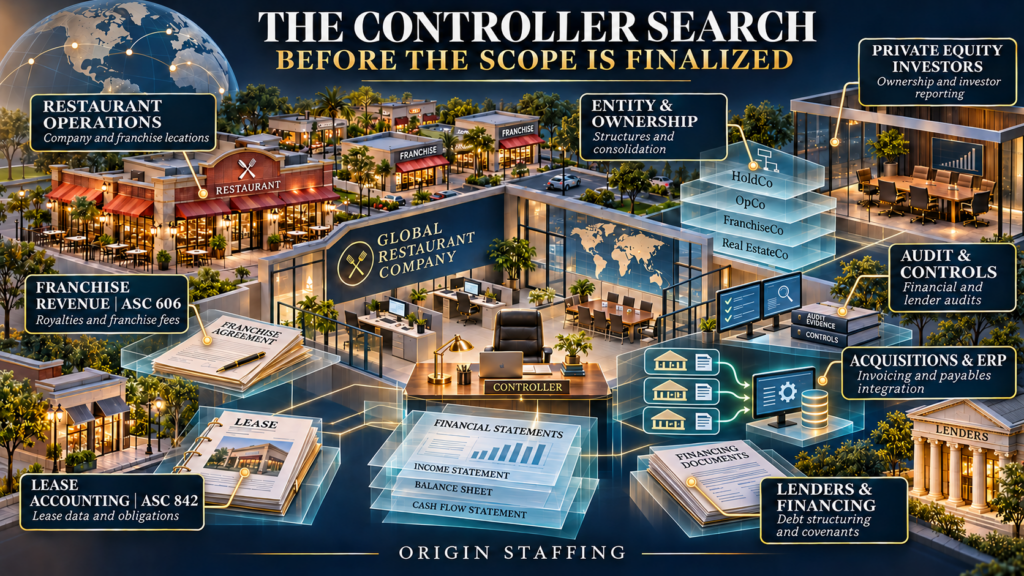
A restaurant and franchise business needed a Controller as its accounting needs were expanding. The role touched franchise revenue, leases, audits, financing and the integration of acquired operations and accounting systems. Origin Staffing, an accounting and finance recruiting agency, worked with the client as the mandate took shape and placed a candidate with public accounting, hospitality and franchise experience.
Estimated reading time: 8 minutes
In this article
- A Controller search with an evolving scope
- Franchise revenue and ASC 606
- Lease accounting and ASC 842
- Bringing acquired businesses and systems together
- Audits, investors and lenders
- Assessing the experience behind the title
- How to hire for an evolving Controller role
- Frequently asked questions
A Controller search with an evolving scope
A restaurant and franchise business came to Origin Staffing looking for a Controller. The need for accounting leadership was clear, but the full scope of the position was still developing.
As discussions progressed, the picture became more complex. The business needed to manage franchise revenue and lease accounting while supporting audits, investors and lenders. It was also bringing acquired operations together and implementing a new operational accounting platform for invoicing and accounts payable, alongside the integration of existing ERP and billing systems.
Those responsibilities call for more than a Controller who can run a close. The company needed to understand where technical accounting, operational leadership and systems integration would meet—and which work the new hire would own versus coordinate with the rest of the team.
Origin worked with the client as the mandate became clearer and the team evaluated candidates. The person ultimately placed brought public accounting, hospitality and franchise experience. The role was remote, which mattered to the candidate alongside the substance of the opportunity.
Franchise revenue raises questions beyond the close
A franchise business may receive initial and renewal fees, royalties tied to franchisee sales, and payments connected to advertising or other services. Collecting the cash and recognizing the revenue are not necessarily the same event.
Under ASC 606, where U.S. GAAP applies, the accounting depends on the contract, the promises made to the franchisee and when the company satisfies its performance obligations. A Controller needs to understand the policy and whether the systems produce the information needed to apply it consistently.
Consider an unrelated public example: Restaurant Brands International’s 2025 annual filing describes recognizing certain initial and renewal franchise fees over the applicable agreement term while recognizing its sales-based royalties as the related franchise sales occur. That illustrates how two payments under the same broad business model can produce different accounting. The result for another company depends on its own agreements and facts. FASB’s revenue recognition overview explains the underlying framework.
For a hiring team, the useful question is not simply whether a candidate has seen ASC 606. Can the person explain a franchise arrangement, the judgments their team made, and how revenue and deferred balances were supported at close and during an audit?
Lease accounting depends on the relationship behind the location
A restaurant company may operate in space it leases, own a property leased to a franchisee, or lease a site and sublease it. The company’s role in each agreement affects the accounting and the supporting information it needs.
Where U.S. GAAP and ASC 842 apply, a lessee generally recognizes a right-of-use asset and lease liability for leases longer than 12 months. Lease terms, renewal options, modifications and the accuracy of the underlying data can all matter. A company that is also a lessor or sublessor has additional considerations. FASB’s lease accounting overview describes the framework.
The hiring team should decide whether the Controller needs to perform the technical analysis, review a specialist’s work, lead the audit support or improve the process that produces the lease data. Those are different demands on the role.
Acquisitions turn accounting systems into a leadership issue
The search also involved a company bringing acquired operations together while implementing a new operational accounting platform. Global invoicing and accounts payable were part of that effort, as was bringing ERP, billing and payables processes into a more coordinated operating model.
That creates practical questions a Controller has to resolve with the finance and technology teams. Are vendors and customers recorded consistently across systems? What happens to open invoices and payables during a transition? How will balances be reconciled, approvals maintained and historical information retrieved for an audit?
Integration also has a people dimension. An acquired team may know its process well, while the central team needs consistent information across the business. A strong Controller should be able to work through those differences, explain what the accounting function needs from a new system and recognize when a proposed shortcut creates a control problem.
The candidate does not have to be the person configuring the software. The relevant experience may be defining accounting requirements, testing processes, overseeing data reconciliation or coordinating with IT, implementation partners and business leaders. The company should be clear about which of those responsibilities it expects the Controller to lead.
Auditors, investors and lenders need different information
Outside private equity ownership can add reporting expectations to a restaurant operating company. Multiple entities, franchise relationships, financing arrangements and acquisitions can make the information behind those reports harder to assemble.
Independent auditors need support for the financial statements. Investors may focus on performance across entities and operations. Banks and other lenders may require financial reporting, covenant calculations or other information under their agreements. These audiences can draw on the same numbers but ask different questions.
That affects the search. Has a candidate coordinated an audit and resolved issues with the auditors? Have they prepared or reviewed lender reporting and understood the definitions in a credit agreement? Or were they several steps removed from that work?
Financing and debt structuring can involve the CFO, treasury, legal counsel and outside advisers as well as accounting. A Controller may need to explain the accounting effects, prepare support and track reporting obligations. The role’s actual authority should be established rather than assumed.
Assessing the experience behind the title
In this search, relevant industry and accounting experience became easier to evaluate as the client clarified the work. Public accounting gave the selected candidate a technical foundation; hospitality and franchise experience added context for the business.
For a comparable search, the assessment should follow the work the company needs done:
| Area to assess | Evidence to look for | A useful follow-up question |
|---|---|---|
| Franchise revenue | ASC 606 work involving fees, royalties or related agreements | What did you personally analyze, and how did you support the recognition policy? |
| Leases and ASC 842 | Technical analysis or informed review of lease accounting | What judgments, data or modifications did your team handle? |
| Acquisitions and systems | Integration, ERP, invoicing or payables experience | What did you own during the transition, and how were balances reconciled? |
| Close and entities | Multi-entity reporting, controls or consolidation experience | Which entities did you oversee, and how did you resolve intercompany issues? |
| Audits and lenders | Audit coordination or financing-related reporting | What did auditors or lenders request, and what did you prepare or review? |
| Leadership and motivation | Fit with the team, authority and work arrangement | What support and decision-making authority would you need to succeed? |
The answers help distinguish someone who worked near a project from someone who owned a meaningful part of it. They also help identify where a strong candidate can learn, provided the essential accounting requirements are covered.
A remote arrangement can widen the candidate pool and mattered to the person who accepted this role. It did not replace the need to understand the candidate’s interest in the mandate, the team and the work ahead. Throughout the interview process, Origin helped the candidate prepare for conversations and stay informed as the client’s team became involved.
How to hire for an evolving Controller role
- Start with the business need.
Separate the immediate close, reporting or audit priorities from longer-term integration and systems work.
- Map the accounting model.
Identify the relevant entities, franchise agreements, leases, acquisitions, systems and reporting obligations. Determine which issues are material to this role.
- Set the boundaries.
Establish the reporting line, team, authority, work arrangement and compensation framework. Clarify what the Controller will own and what remains with the CFO, treasury, IT or advisers.
- Talk through the candidate market.
Contact Origin Staffing to discuss the mandate and the trade-offs between direct franchise experience, technical accounting and systems leadership.
- Ask for evidence of ownership.
Use specific examples: a revenue policy, lease judgment, audit issue or systems transition. Find out what the candidate did, who supported the work and what decisions they made.
- Keep candidates informed.
Align interviewers on the role, communicate what is still being decided and resolve material changes before an offer.
Frequently asked questions
Yes. A search partner can help clarify the need while evaluating the market. Key responsibilities, authority and compensation should be resolved as the process advances.
Sometimes. Identify the franchise, lease and operating issues that require direct experience, then test whether an adjacent background addresses the same work.
Franchise fees, royalties and services may have different recognition patterns. The accounting depends on the agreements, performance obligations and applicable guidance.
That depends on the lease portfolio and the team. Determine whether the person must perform technical work, review it, support the audit or improve the underlying process.
Ask what the person owned, how data and balances were reconciled, and how accounting worked with IT and implementation partners. A system name alone does not establish ownership.
Look for the candidate’s role in preparing, reviewing and explaining information. Financial statement audits and lender requests may have different purposes and requirements.
It can widen the pool and appeal to candidates who value flexibility. The employer still needs to assess the person’s experience, interest and ability to work with the team.
Share the work and conditions that can be disclosed. Be clear about what remains confidential or undecided and when more information may be available.
About the search
This search was led by Devin Martinez at Origin Staffing. If your team is considering a Controller or another accounting and finance hire, contact Origin Staffing to discuss how our recruiting agency can help.
For related reading, see A+ Finance Hiring Beyond Titles and our Assistant Controller search case study.