
Origin Staffing - Thoughts on Recruitment
The Private Equity Data Governance Search That Started in Finance
Home › Origin Staffing Blog › Private Equity Data Governance Recruiting
By Andrei Nikulin, Head of Recruiting, Origin Staffing | November 27, 2026
Estimated reading time: 11 minutes.
“Data governance” was in the title. This private equity data governance search started inside the firm’s finance and operations teams.
A global firm wanted to improve how information moved through its finance and operations teams: from the systems used by fund controllers to the reports and analyses used across the business. The firm already had technical resources and an established governance framework. It still needed someone who understood private equity fund workflows well enough to put that framework to work.
That distinction shaped a search we led at Origin Staffing—and it changed how we evaluated the market.
At a glance
- The mandate: A business-facing data governance leader for private equity fund finance and operations.
- The search: Origin worked with finance and data leadership to refine the role, assess transferable experience and reach candidates beyond a title match.
- The wider context: Clear data definitions, ownership and access can support reliable reporting and the use of AI across a private equity firm.
In this article
- The conversation behind the job description
- Where the data goes in a private equity firm
- Search dynamics: finding and attracting the right people
- Why the AI conversation makes the work more urgent
- Governance is also a control issue
- What I would ask in the next search
- How to hire a private equity data governance leader
- Frequently asked questions
The conversation behind the job description
Our intake included the firm’s private equity CFO and a senior data management leader. We spent time on what the person would actually do: work with fund controllers, map existing processes, identify inconsistent data and manual work, and help finance and technology teams agree on improvements.
This was not a coding position. It called for enough technical fluency to work productively with data and systems teams, but the center of gravity was finance. A candidate who understood governance terminology but had never worked through the complexities of private markets fund operations would face a steep learning curve.
The reverse was also true: a strong fund finance professional needed more than an interest in technology. We had to understand whether they had personally improved a process, worked across functions and stayed involved beyond initial approval.
Leveling was flexible. As conversations with leadership and candidates developed, the firm became open to a more senior hire who could bring the necessary experience and still be close to the work.
Where the data goes in a private equity firm
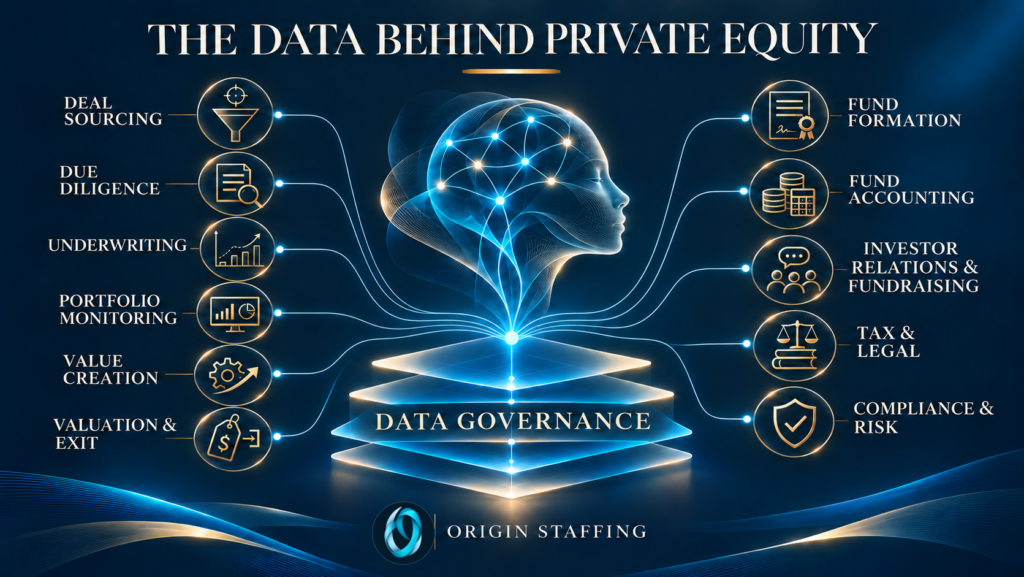
The role centered on finance and operations, but the information those teams manage connects to decisions across the firm. A portfolio company can appear in an underwriting model, a fund’s books, a valuation analysis and an investor report. Each view may serve a different purpose, rely on a different period or use a different definition of earnings.
For example, take adjusted EBITDA. One company’s figure might include projected cost savings; another might include only savings already realized. Before anyone compares the two—whether in a spreadsheet or with an AI tool—someone needs to understand the definitions and source data.
That business context mattered in our candidate conversations. In particular, we discussed how private equity information moves between funds, finance teams and systems, and looked for people who could identify where processes break down and who needs to resolve them.
Private equity workflows and data governance
Examples across private equity:
| Business area | Potential AI or analytics use | Governance question |
|---|---|---|
| Deal sourcing | Screen companies and surface targets. | Are company identities, ownership, industry tags and external data current and consistent? |
| Due diligence | Review data-room documents and flag contract or customer risks. | Is the tool reading the latest permitted documents, and can reviewers trace each finding to its source? |
| Underwriting and investment committee | Organize financial history, comparables and scenarios. | Can teams distinguish estimates from actuals, and are definitions, currencies and assumptions clear? |
| Portfolio monitoring | Extract revenue, margin and operating metrics from company reports. | Are periods, currencies, business units and KPI definitions comparable across companies? |
| Operating value creation | Analyze pricing, customer retention or procurement across portfolio companies. | Can teams combine the data for that purpose while protecting confidential customer and supplier records? |
| Valuation and exit | Assemble comparable transactions, financials and draft buyer materials. | Which inputs did the team approve, what changed since the prior valuation, and who signs off? |
| Fund formation and side letters | Compare draft agreements, subscription documents and investor terms. | Which fund, investor and document version does each obligation apply to? |
| Fund accounting, fees and carry | Help reconcile capital activity or review waterfall calculations. | Do commitments, contributions, distributions, fee bases and allocation rules map to the correct fund and investor? |
| Investor relations and fundraising | Draft responses to due diligence questionnaires and investor updates. | Are performance figures current and gross or net as intended, and is the recipient entitled to the information? |
| Tax and legal entities | Extract information from tax documents and entity records. | Do records correctly link the investment, entity, investor and tax year, and do only authorized users have access? |
| Compliance and information security | Help identify exceptions, conflicts or unusual access. | Who can see restricted information, who reviews an alert, and how is the decision recorded? |
What a governance leader needs to connect
No one person owns every calculation or control in that table. The leadership challenge is knowing who owns each decision, getting the right people involved and following through until they resolve the issue.
Search dynamics: finding and attracting the right people
The job title alone was a poor filter. Instead, we considered people from private markets finance, investment operations and transformation backgrounds, including candidates whose titles did not say “data governance.” Their experience with fund structures, reporting, process design and cross-functional execution was more informative than an exact title match. We encountered a similar balance of finance knowledge and execution in a finance analytics search for an alternative asset manager.
We also had to explain the opportunity clearly. For example, someone already leading transformation at another firm may not be interested in a vague promise to “own data.” The more useful conversation is about the team they will work with, the processes they can improve, the authority they will have and how the position can grow. In this search, those conversations included the chance to work alongside finance leadership and fund controllers while helping build out a business-facing governance function.
The firm hired a professional with private markets experience and a track record working across data, reporting and business teams. Just as important, the scope and level made sense for a senior professional who would still need to stay involved in execution.
Why the AI conversation makes the work more urgent
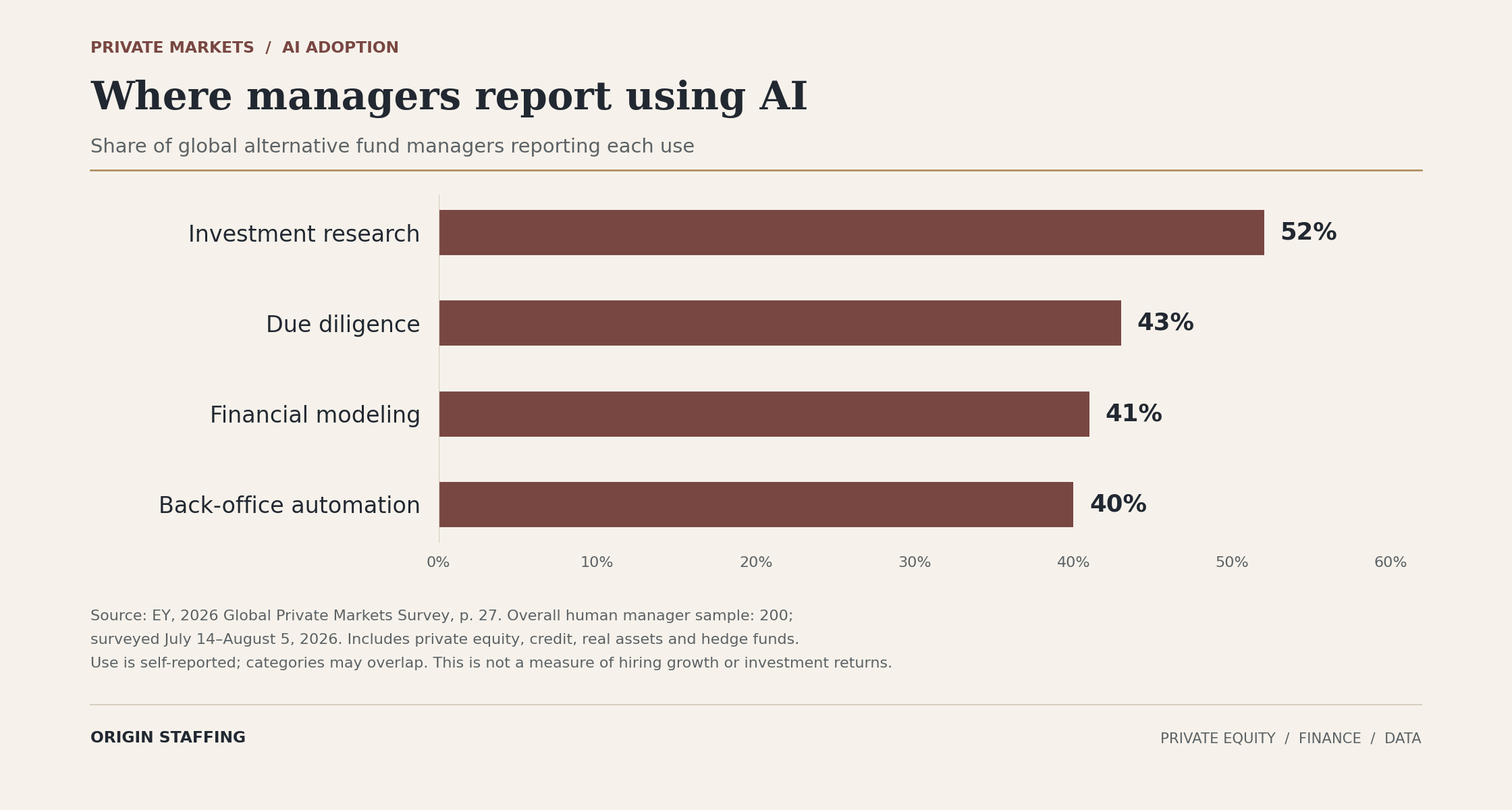
In its November 2026 Global Private Markets Survey, EY found that managers reported using AI in investment research, due diligence, financial modeling and back-office automation. The survey covered 200 alternative fund managers globally, including private equity and other strategies.
The tools are moving into specific workflows. For example, in October 2026, PitchBook announced agent capabilities and a data connection for company, deal, investor and fund information. That same month, Latham & Watkins and Harvey announced work on fund-formation tools involving agreements, side letters and subscription documents.
Those developments are promising, but use and trust are different things. An S&P Global survey found skepticism about AI’s effectiveness in sourcing and portfolio monitoring. A capable tool still needs the right information, appropriate access and a way for people to check its work.
In Machines of Loving Grace, Dario Amodei asks what may constrain progress as intelligence improves. His 2024 essay is broader than private equity, but the question is relevant here. My view: the quality and availability of a firm’s information can limit what it gets from even a very capable model.
Governance is also a control issue
For investor relations, a data error might mean sending an LP information intended for another investor. A legal summary might miss a negotiated side-letter exception; finance might use the wrong fee base or an outdated fund ownership figure. Each problem has a different owner and consequence.
The Institutional Limited Partners Association’s reporting and performance templates address items including fees, expenses, carried interest, returns and cash flows. The SEC’s fiscal 2027 examination priorities also identify private-fund disclosures, fees, expenses and controls as areas of focus. ILPA’s templates are industry guidance; examination priorities are not new rules. Together, they show why finance teams need to know where information comes from and how it is used.
What I would ask in the next search
For a finance-facing mandate like this one, I would ask a candidate to walk through a fund reporting or operating process they improved, from the source data to the person using the final output. Then I would listen for four things:
- Business context: Did they understand the fund structure and why the information mattered?
- Personal ownership: What did they change themselves, and what did other teams own?
- Execution: How did they handle exceptions, build agreement and get people to use the new process?
- Technical judgment: Can they work with systems and data teams and explain how outputs were checked?
For a more technical architecture or engineering role, the assessment would change. For example, the role might require much deeper technical skills and less fund accounting experience. The mandate—not the title—should determine the search. In our senior director data governance case study, we discuss governance across investment operations and reporting.
How to hire a data governance leader for private equity
Start with the work the hire must own. Then define the talent market and run a process that makes sense for both the firm and the candidate.
- Define the business problem
Bring finance, fund operations and data leaders together. Identify the reports, processes, definitions and handoffs that cause the most friction, and decide what the new hire must improve first.
- Set the scope and level
Decide whether the work calls for fund finance expertise, governance program leadership or deeper technical architecture. Then clarify reporting lines, decision authority, resources, compensation and location.
- Talk through the mandate with Origin
Share your notes with our recruiting team. We can discuss the market, pressure-test the requirements and help shape a compelling opportunity before you finalize a job description.
- Map the market beyond job titles
We look across private markets finance, investment operations, financial systems and transformation, and approach relevant people who may not be applying to posted roles.
- Assess evidence of ownership
Ask candidates to trace a process from source data to its users. Explore what they personally changed, how they handled disagreements and whether the new process took hold.
- Run a coordinated interview and offer process
Agree on the assessment, interviewers, compensation and decision timeline. Keep candidates informed, address trade-offs and build an offer around the role and the person you want to hire.
At Origin Staffing, we conduct permanent searches across fund finance, investment operations, data governance, analytics, financial systems and transformation. If you are defining a role at that intersection, contact our team to discuss the work and the market for talent.
Frequently asked questions
For a role embedded in fund finance, it can be critical. A central engineering role may require deeper technical expertise instead. Start with the work the person must own.
Look beyond governance titles. Fund finance, private markets operations, reporting and transformation teams can produce strong candidates if they have improved processes and worked across functions.
Ask them to walk through a specific process they changed: what was broken, what they personally did, who owned the data and how the new process was adopted.
Explain the actual mandate, the quality of the team, decision authority and room to grow. Strong candidates want to know what they can improve and who will support them.
No. Data governance addresses how teams define, manage and use information. AI governance also covers how firms select, test and monitor AI systems, and which actions those systems can take.
No. Some sit in finance or operations; others are central data, technology or engineering roles. Reporting line and technical depth should follow the assignment.
Yes. We run permanent searches in fund finance, investment operations, financial systems, data and analytics, transformation and related leadership positions.
Andrei Nikulin | Head of Recruiting, Origin Staffing
Contact Origin Staffing to discuss a data governance, fund finance or transformation search.