
Origin Staffing - Thoughts on Recruitment
Recruiting a Finance Transformation Leader for a Consulting Firm
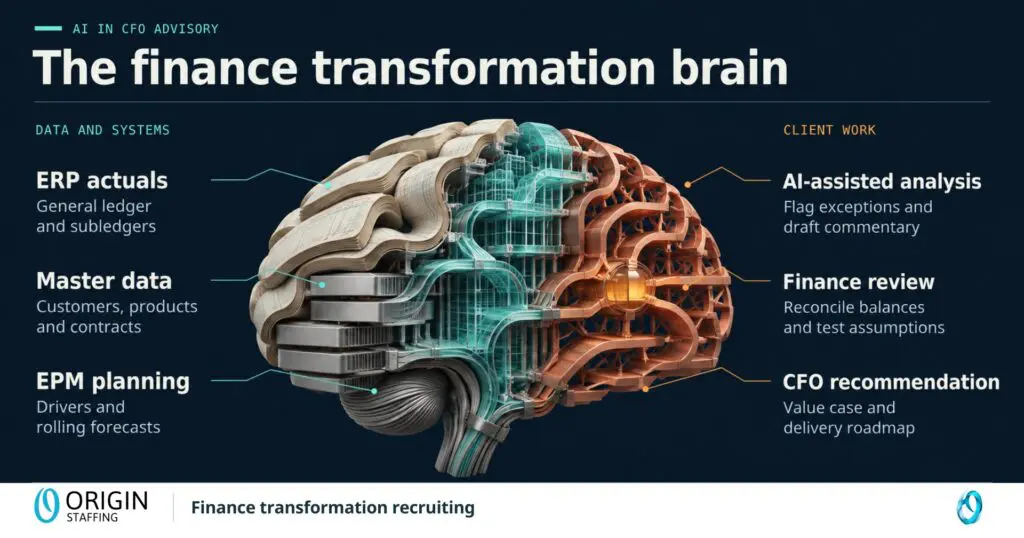
AI can flag an exception or draft commentary. The consultant still has to reconcile the figures, test the assumption and tell the CFO which change is worth funding. View the full-size finance transformation brain.
Read the finance transformation brain diagram
The data inputs are ERP actuals from the general ledger and subledgers, customer, product and contract master data, and EPM drivers and rolling forecasts. AI can flag exceptions and draft commentary. A finance reviewer reconciles balances and tests assumptions. The consultant presents the value case and delivery roadmap to the CFO.
Home › Search Agency Case Studies › Finance transformation recruiting
By Devin Martinez · May 4, 2026
Estimated reading time: 8 minutes
Executive Summary
- A national consulting firm nearly passed on a finance transformation candidate whose résumé emphasized systems implementation.
- In industry, he had owned annual planning and worked with finance and sales on the forecast. He completed a client-style case exercise and accepted the firm’s offer.
- That distinction matters when AI can help draft the slides and a client still expects someone to defend the assumptions.
In this article
- The Broader Market Moment
- The Profile the Market Could Misread
- Why the Fit Took Work
- Where AI Actually Shows Up in This Work
- What Our Finance Transformation Recruiters Screened For
- The Turning Point
- How AI Is Showing Up in Finance Transformation Interviews
- What This Search Says About the Market
- How to hire a client-facing finance transformation leader
- Frequently asked questions
- Related reading
- Work with Origin Staffing
The Broader Market Moment
For a consulting partner, the AI question goes beyond an enterprise program. What are high-performing professionals doing with AI in their own workflows? That is especially relevant in transformation-heavy roles where the work depends on pulling together messy information, structuring recommendations, and presenting clearly to leadership.
As finance transformation recruiters, we look for people who can connect business needs, financial realities, and modern tools without losing the human side of the work. They can use AI to reduce the manual work around analysis, synthesis, and presentation prep, then spend more time on judgment, communication, and problem-solving.
The Profile the Market Could Misread
The professional at the center of this search had a Big Four finance transformation background and later moved into a business operations leadership role in industry. That combination created real depth, but it also created risk in the hiring process.
On a resume, broad profiles can be easy to oversimplify. Some reviewers see systems language and assume pure implementation. Others see industry operations and assume the consulting edge is gone. In reality, the best version of this profile was neither narrow nor generic. It was strategic, commercially aware, presentation-ready, and unusually well suited to work that sits between finance, systems, and business operations.
He was confident, thoughtful, and looking for the right next challenge. He wanted to get back to the kind of strategic work he loved without going back to the kind of lifestyle that once came with it. The flexibility of the consulting opportunity mattered to him.
Why the Fit Took Work
This was not a simple “submit and close” search.
The first read on the profile leaned too heavily on implementation language and not enough on the broader operating experience behind it. We saw something else: an operations-focused finance transformation specialist who happened to have significant systems and enterprise performance management (EPM) experience, but whose real value came from strategy, planning, operating-model thinking, and the ability to present credibly in front of leadership.
One example helped us explain the fit. In consulting, he had helped finance teams move from a static annual plan to rolling forecasts. In industry, he had owned the annual planning process himself. He could talk to a client about what happens to a model after the implementation team leaves.
The practice needed someone who could connect the tools to the business case, the process redesign, the stakeholder conversation, and the final recommendation. Once that became the framing, the fit made much more sense.
Where AI Actually Shows Up in This Work
A consultant can come out of multiple stakeholder meetings with messy notes, spreadsheets, process observations, and competing opinions from different teams. AI can help synthesize those inputs, pull out themes, and shape the first draft of a leadership presentation. But the quality of the final recommendation still depends on the person doing the work.
Consider a forecast review. An AI draft attributes a revenue shortfall to lower demand. The consultant checks with sales and learns that several orders moved into the next month. Those explanations call for different advice.
In a field experiment with 758 consultants, AI helped on some tasks. On a business problem the model handled poorly, consultants with AI were less likely to reach the correct answer. For an interviewer, the follow-up is simple. What did you check before you took that recommendation to the client?
In finance transformation work, AI is especially useful in these three areas.
- workflow automation around repetitive prep work
- faster reporting and analysis
- reduction of manual consulting tasks before decisions and presentations are made
The human side still decides what matters, what should change, and how to explain it.
What Our Finance Transformation Recruiters Screened For
As in our other search case studies, the evaluation had to go beyond title matching.
Our scorecard focused on the following areas.
- strategic finance transformation depth
- business operations credibility
- client-facing communication strength
- AI awareness at both workflow and market level
- leadership presence
- ability to translate broad experience into a clear story
- readiness to return from industry into consulting
- fit for a flexible, remote-friendly environment
- close likelihood based on motivation and timing
The proof prompts were just as important.
- Walk me through how you turn messy information into a leadership-ready recommendation.
- How are you using AI today in your own workflow?
- Show me where your work changed a finance or operating process, not just a system.
- What did you build versus inherit?
- How do you present technical business needs to less technical stakeholders?
That is what human-first recruiting in an AI-supported market looks like. AI can help speed up prep, pattern recognition, and process hygiene. It should not replace the call, the judgment, or the real conversation.
The Turning Point
The turning point came when he got in front of the right interviewer and finally felt understood.
A strong search often changes when the candidate meets someone who can see the background in motion rather than as a static list of keywords.
A practice interviewer recognized the connection between his consulting experience and the planning decisions he had owned in industry. A later interviewer asked him to frame the case exercise as a presentation for a client. He completed it, the firm made an offer, and he accepted.
It reconnected him with the kind of work he had missed. He was weighing another opportunity, and the flexibility of a return to advisory also mattered to his decision.
How AI Is Showing Up in Finance Transformation Interviews
For this kind of hire, a candidate should have a thoughtful point of view on two levels. What does AI mean for the enterprise, and what does it mean for their own daily workflow? One of the clearest questions hiring teams can ask is simple. How are you using AI today in your own workflow?
It helps separate people who talk about AI in abstractions from people who understand how it improves actual work. Candidates who answer well are usually specific. They talk about synthesis, reporting prep, workflow acceleration, and better decision support. They do not pretend the tool is doing the thinking for them.
Broad applications and vague AI language are not enough. Candidates need a tighter story than that.
A candidate preparing for that conversation can use our finance interview preparation guide and bring one example of a draft they corrected before sharing it.
What This Search Says About the Market
This search reinforced three things.
First, employers can screen out hybrid backgrounds because they do not fit a clean bucket quickly enough. That nearly happened here.
Second, candidates hurt themselves when they apply too broadly instead of translating their experience with more precision.
Third, AI is raising the bar for this kind of work. A practice needs professionals who can use modern tools well and then spend the saved time on the parts of the job that still require trust, taste, and judgment.
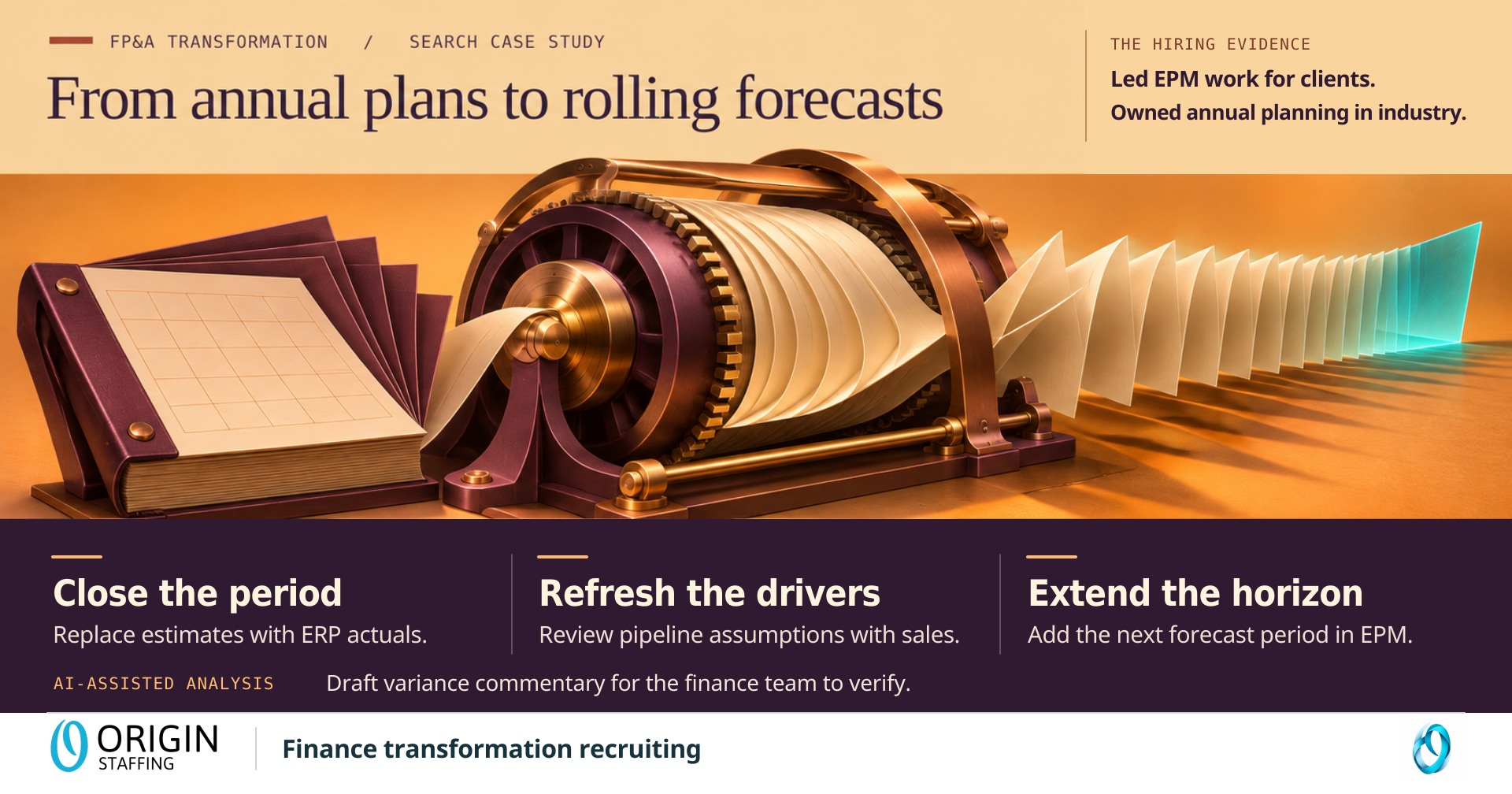
Read the rolling forecast diagram
At each close, the finance team replaces estimates with ERP actuals, reviews pipeline assumptions with sales and adds the next period to the EPM forecast. AI can draft variance commentary for finance to verify. The candidate led EPM work for clients and owned annual planning in industry.
How to hire a client-facing finance transformation leader
- Define the first client assignment.
Have the practice lead describe a decision the hire will help a CFO make. Agree on the finance experience, client responsibility, travel and level it requires.
- Look across advisory and industry.
A former consultant who now owns planning in a business may be worth a conversation. If the shortlist is all implementers, bring the mandate to Origin’s finance recruiting team and walk through the first assignment together.
- Test the recommendation.
Give finalists the same short finance case. Ask which assumption they would challenge, what they would verify, and how they would explain the answer to the client.
- Set the decision timetable.
Name the interviewer who can judge client delivery. Set the case deadline and offer decision in advance, and ask candidates what other timing commitments they have.
Frequently asked questions
AI can take a first pass at reporting, analysis and presentation prep. This search still called for someone who could challenge the assumptions and explain a recommendation to a client.
In advisory work, people who understand both a finance process and the systems behind it can judge whether an AI draft makes business sense. Ask where they have done that.
Because hiring teams often screen by label before they screen by logic. Origin Staffing sees this often in transformation searches where the best fit does not look obvious at first glance.
One to prepare for is “How are you using AI today in your own workflow?” Strong answers are practical, specific, and grounded in real work. Give one example of a draft you checked or changed.
Avoid vague enthusiasm. Candidates should explain where AI speeds up prep, synthesis, reporting, or analysis without pretending it replaces judgment.
They often over-index on narrow keywords and underestimate hybrid experience. That can cause strong transformation talent to get screened out too early.
Origin Staffing uses AI to support process speed and preparation, not to replace human interaction. The real recruiting value still comes from conversation, filtering, and judgment.
Apply with more precision, not just more volume. A tighter story, a clearer resume, and a more thoughtful interview approach usually outperform broad, low-conviction outreach.
Related reading
Work with Origin Staffing
If you’re hiring someone to lead finance transformation work for clients, talk with Origin Staffing about the search. Tell us which client assignment this person would own first. That is a useful place to start, even before you have a finished job description.
Search and case study led by Devin Martinez, Recruiting Manager at Origin Staffing.